About Nocomis biguttatus (Kirtland, 1840)
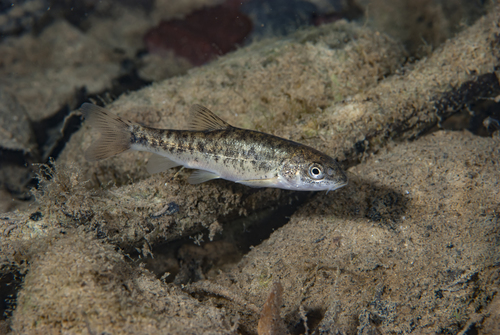
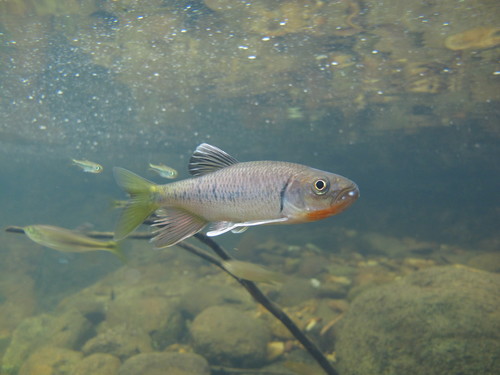
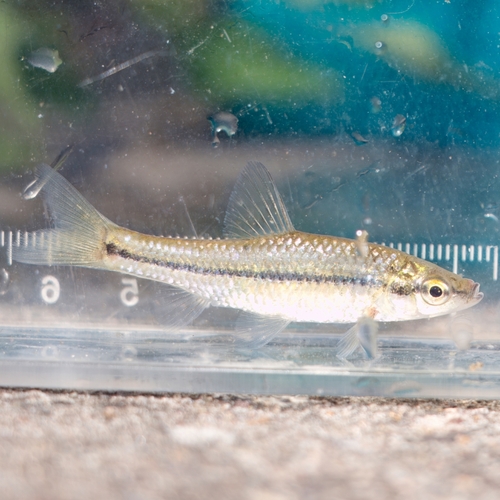
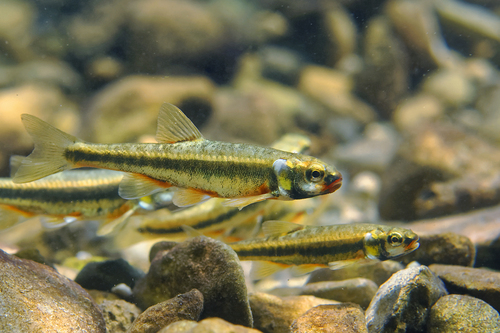
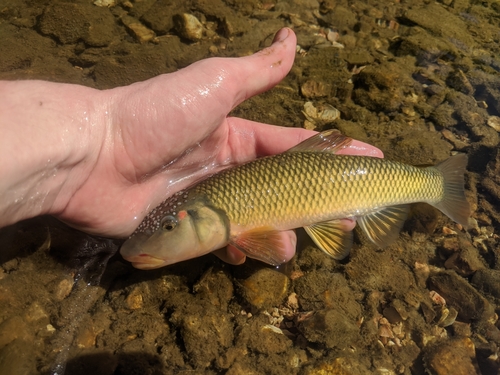
The hornyhead chub (Nocomis biguttatus, Kirtland, 1840) is a moderately sized fish with a slightly subterminal mouth and an inconspicuous barbel at the corner of the mouth. This species has no teeth. Its back is olive brown, its sides are silvery, and its belly is white. It has a dark lateral stripe and a spot at the base of the tail; this spot is faint or absent in some adults. Its fins have decorative markings. The body is fusiform, robust, and round in cross-section. Typical adult total length is 100–150 mm (3.9–5.9 in), with a maximum total length of about 225 mm (8.9 in). It has a forked tail and a single relatively short dorsal fin with 8 rays and no spines. Its pelvic fins are positioned abdominally, and it lacks an adipose fin. Its anal fin has 7 rays and no spines. Key distinguishing characteristics are its slightly subterminal mouth and the inconspicuous barbel at the mouth's corner. It also has 38–48 lateral line scales, plus the diagnostic dark lateral stripe and caudal spot. Breeding adults develop numerous large pointed tubercles on the top of the head, smaller tubercles on the pectoral fins, and a red or orange spot on the upper opercle behind the eyes. Juveniles resemble adults, but have more prominent lateral stripes and caudal spots, and their tails are typically more reddish than adult tails. The hornyhead chub's range extends from Wyoming, North Dakota, and South Dakota east to the Hudson River drainage, and south to Oklahoma. South Dakota marks the western edge of the species' overall range. It has been recorded in multiple water bodies in the Minnesota River Basin, including the north and south forks of the Yellowbank River, Monigan Creek, Cobb Creek, Whetstone Creek, the North Fork of Whetstone Creek, and Gary Creek in Roberts, Grant, and Deuel Counties, as well as Big Stone Lake in Grant County. Hornyhead chubs were documented in the Big Sioux River drainage in 1952, but the exact location of this record is unknown. No individuals have been recorded in the Big Sioux River drainage since 1952, and the species is likely extirpated from this watershed. It also occurs in the Mississippi River basin, Red River drainage, Ohio River, and lower Kentucky River systems. Its broader distribution spans from New York west into the Dakotas, with isolated populations in the Platte and Colorado River Systems, ranging north to Manitoba and south to Kentucky. Populations also exist in Georgia, in Rock Creek below Chattahoochee Forest National Fish Hatchery and the Toccoa River in Suches. Hornyhead chubs occupy rocky pools and runs of creeks and small to medium-sized rivers, living in riffle and pool sections of these waterways. While they are occasionally found in dark-water streams, they are most common in clear-water streams. Their presence is inversely related to water turbidity. Aquatic vegetation does not appear to affect adult abundance, but young hornyhead chubs rely heavily on vegetation for cover, and occur in higher concentrations in vegetated areas during the first several weeks to one month of life. This species is most commonly found at water depths of 2–6 ft (61–183 cm). Hornyhead chubs spawn between May and June. Individuals reach sexual maturity at 2 to 3 years of age. Males construct cup-shaped nests from pebbles that can measure 1–3 feet (0.30–0.91 m) across and 6–8 inches (150–200 mm) high. Eggs and sperm are released into depressions in the nests, then covered with gravel. Males defend their nest mounds from other male N. biguttatus, but do not defend nests against other fish species. Other fish species take advantage of this defense and spawn in the hornyhead chub nest mounds, which sometimes results in accidental hybridization. A single male may spawn with multiple females.