About Ninox superciliaris (Vieillot, 1817)
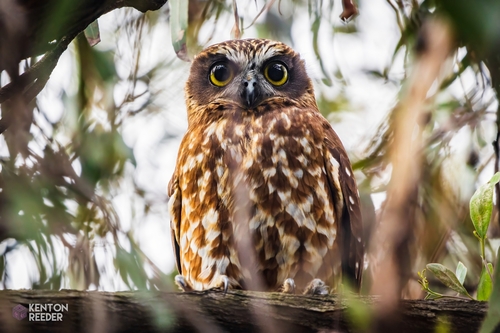
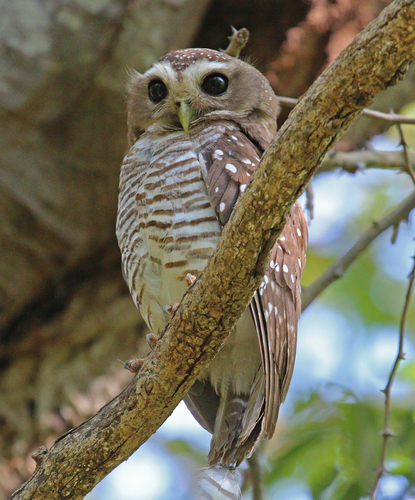
The white-browed owl, with the scientific name Ninox superciliaris (Vieillot, 1817), is a short, stocky owl with a large, rounded head and no ear tufts. Adult individuals have brown upperparts marked with white spotting on the crown, mantle, and wing coverts. They have a grey-brown facial disc, prominent bold white eyebrows, and a buff chin. Their underparts are buff-colored with broad dark brown barring, while their underwings, vent, and legs are solid pale buff, and their tail is solid plain brown. The owl's bill and cere are horn-colored, its eyes are dark brown, and its legs and feet are pale yellow. This species reaches a length of approximately 25 cm (9.8 in) and a wingspan of approximately 70 cm (28 in).
The white-browed owl is endemic to Madagascar, where it can be found in the northeast, south, and southwest regions of the island. It is most common in the drier forests and gallery forests of southern and western Madagascar, and less common in the humid rainforest of the northeast. It also lives in cultivated areas and secondary forest, and occurs mainly in lowland areas, with an upper elevation limit of 800 m (2,600 ft) above sea level.