About Ninox strenua (Gould, 1838)
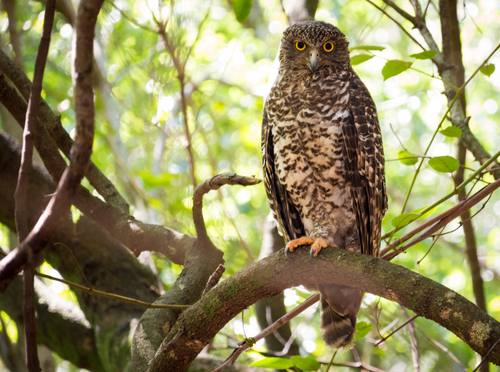
Ninox strenua, commonly known as the powerful owl, has a long tail and small head that create an unusual silhouette for an owl, giving it a more hawk-like appearance than any other large owl. Its protruding bill and distinct brow ridges further enhance this hawk-like look, and its facial disc is poorly defined. The upperparts of the powerful owl are dark grey-brown, with whitish mottling and barring; the underparts are white, marked with bold, grey-brown V-shaped bars. Its tail features six narrow white bars that contrast with its grey-brown base colour. This species has large yellow eyes, greyish feathering that extends down to the base of the toes, and dull yellow feet. As its common name suggests, the powerful owl has very strong, heavy claws. It is the largest species in the genus Ninox, the 'hawk owl' group found across most of Asia and the Australasian region. Alongside its sister species the rufous owl (N. rufa), it is considered Australia's ecological equivalent to the genus Bubo. The powerful owl measures 45 to 65 cm (18 to 26 in) in body length, with a wingspan of 112 to 135 cm (44 to 53 in). Unlike the vast majority of owl species, males are on average slightly larger than females. Reported body mass for males ranges from 0.99 to 2.22 kg (2.2 to 4.9 lb), with an average of 1.45 kg (3.2 lb) from a sample of 13 males; female body mass ranges from 1.04 to 1.6 kg (2.3 to 3.5 lb), with an average of 1.25 kg (2.8 lb) from a sample of 9 females. Among all owl species worldwide, the powerful owl ranks ninth in bill-to-tail length, tenth in body mass, and eighth in wing length. Its average body mass is roughly equal to that of the great horned owl (Bubo virginianus), but it has proportionally much longer tail and wings than that species. Wing chord length also shows slight sexual dimorphism favoring males: males measure 397 to 434 mm (15.6 to 17.1 in), while females measure 381 to 410 mm (15.0 to 16.1 in). The tail can reach 280 mm (11 in) or more in length, making it the fifth longest tail among all owls; only the great grey owl (Strix nebulosa) and ural owl (Strix uralensis) have proportionally longer tails. As a relatively geographically restricted species, the powerful owl has no recognized subspecies and no known geographic variation in its traits. Compared to the barking owl (Ninox connivens), the powerful owl is much larger, and lacks the barking owl's white-spotted smoky-brown upperparts and dark grey to rusty streaks on a whitish underbelly. The only other large relatively powerful owl native to Australia, the rufous owl, does not share the powerful owl's wild range, so the two species do not create identification confusion. The powerful owl's range extends from Eungella and the Dawson River in Queensland south to the central highlands of Victoria, and west to Mount Burr in South Australia, with the southern end of the range terminating around Portland, Victoria. Its habitat includes tall humid forests, and extends into some drier woodlands in northern Victoria and the western slopes of New South Wales and Queensland. It can be found in wooded mountain gullies, forested ravines, wetter heavily timbered subcoastal ranges, coastal forests and woodlands, and coastal scrub. It prefers wetter, heavily timbered areas such as sclerophyll forests. While it is usually associated with subcoastal forest, it can occasionally be found on inland mountain slopes, most often young owls that have dispersed before establishing their own breeding territories. Recent mapping shows that streams between ridges covered in Eucalyptus forest are often prime habitat for the species. It also occasionally ranges into plantations (mainly pine or native tree plantations), as well as urban and rural parks and gardens.