About Ninox scutulata (Raffles, 1822)
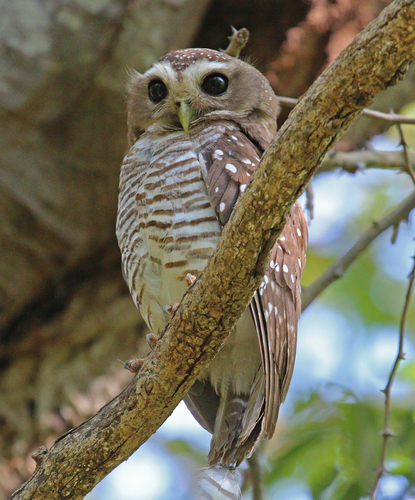
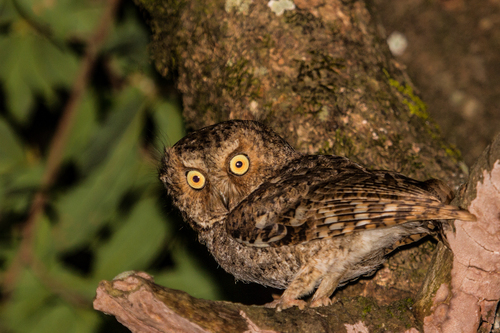
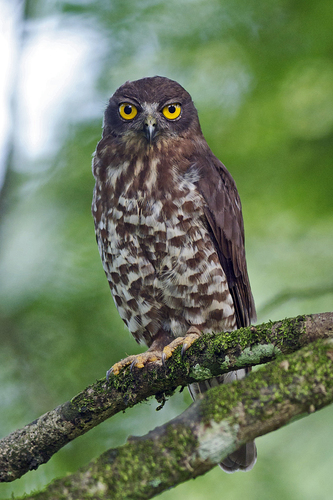
The brown boobook (scientific name Ninox scutulata (Raffles, 1822)) is a medium-sized owl that reaches 32 cm (13 in) in length. It has a hawk-like shape, shaped by its long tail and the absence of a distinct facial disk. Its upperparts are dark brown, and it has a barred tail. The underparts are whitish with reddish-brown streaking; the subspecies native to the Andaman Islands is an exception, with dark brown underparts instead. It has large yellow eyes, and males and females have similar appearance. This species is strongly nocturnal, but it can often be found by tracking small birds that mob it while it roosts in trees. It feeds mainly on large insects, frogs, lizards, small birds, and mice. Its call is a repeated low, soft, musical oo-uk ...ooo-uk..., which can be heard at dusk and dawn. This owl is quite common in towns and cities such as Colombo, Sri Lanka, as well as in suburban areas near buildings. Nine subspecies are currently recognized: N. s. lugubris (Tickell, 1833), found in northern, northeastern, and central India and Nepal; N. s. burmanica Hume, 1876, found from northeast India to south China, Indochina, and Thailand; N. s. hirsuta (Temminck, 1824), found in southern India and Sri Lanka; N. s. isolata Baker, ECS, 1926, found in Car Nicobar; N. s. rexpimenti Abdulali, 1979, found on Great Nicobar Island; N. s. scutulata (Raffles, 1822), found in the Malay Peninsula, Riau Archipelago, Sumatra, and Bangka Island; N. s. javanensis Stresemann, 1928, found in west Java; N. s. borneensis (Bonaparte, 1850), found in Borneo and the north Natuna Islands; and N. s. palawanensis Ripley & Rabor, 1962, found in Palawan, western Philippines. The brown boobook is a resident breeding species across most of tropical south Asia, ranging from the Middle East to south China. It inhabits well-wooded landscapes and forest. It lays three to five eggs in a tree hole. There are two confirmed records of the brown boobook in the western hemisphere: one individual photographed on St. Paul Island, Alaska, on August 27, 2007, and a dead individual found on Kiska Island in 2008.