About Ninox rufa (Gould, 1846)
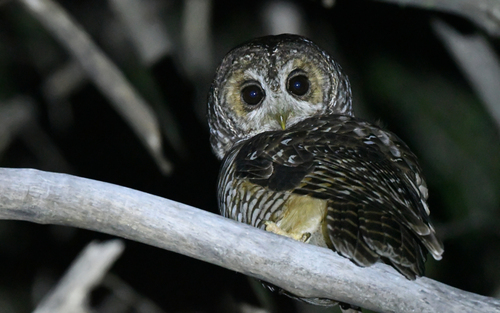
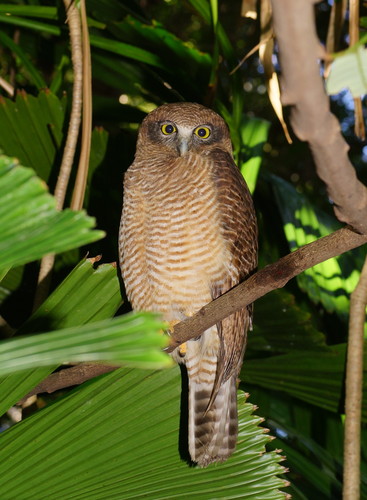
The rufous owl (Ninox rufa) is a large owl species. Adults grow to 46–57 cm (18–22 in) in length, with a wingspan ranging from 100 to 120 cm (39 to 47 in). Females typically weigh between 700–1,050 g (25–37 oz), while males usually weigh 1,050–1,300 g (37–46 oz). Both sexes have relatively small heads for their body and tail size, and the male's head is flatter and broader than the female's. Newborn juvenile rufous owls are much smaller, usually measuring 49–54 mm (1.9–2.1 in) long at birth, and are covered in downy white fur. For adults, the forehead, neck, back, and upper wings are usually dark reddish-brown, scattered with light brown barring. The face is dark brown, while the neck, breast and underparts are rufous marked with thin cream bars. The underside of the wings is light brown with thick cream bars. It has a light grey hooked bill, surrounded by black bristles at the base, and golden-yellow eyes. The rufous owl has a wide geographic range. It is native to the Aru Islands, New Guinea and northern Australia. In Australia, it occurs in Arnhem Land, the northern Kimberleys, eastern Cape York Peninsula, and the Mackay Region of eastern Queensland. It is the only exclusively tropical owl found in Australia. The total global population of Ninox rufa has not yet been determined, and the species is considered uncommon to rare. This owl lives in terrestrial ecosystems. It is mainly found in rainforests and rainforest margins, and may also occur in other forests, moist savannas, and inland wetlands.