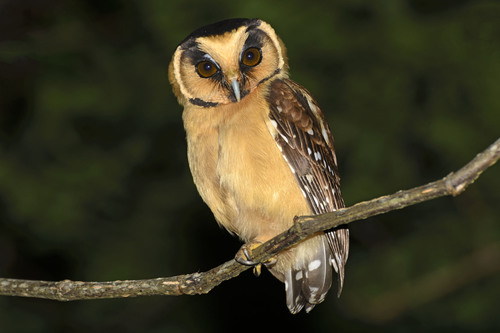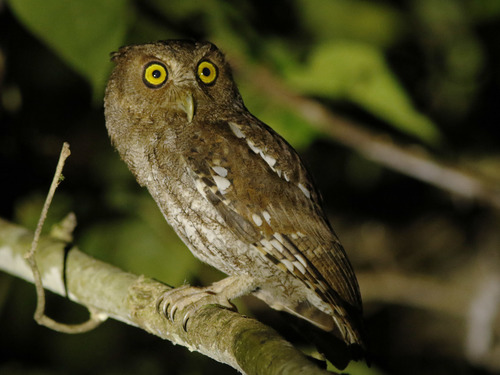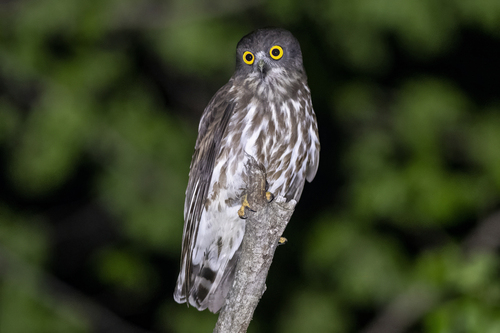
About Ninox japonica (Temminck & Schlegel, 1845)
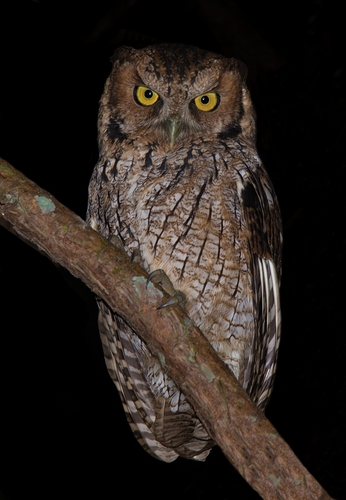
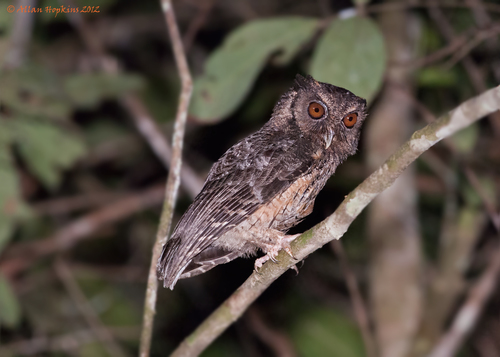
Ninox japonica, commonly called the northern boobook, is a species of hawk owl. On average, its body length ranges from 29 to 33 cm, with a wingspan of roughly 60 to 70 cm, and an average body weight of around 168g. Current research has not identified sexual dimorphism in this species. The northern boobook has a hawk-like appearance, and its subspecies are nearly indistinguishable from one another. This species has a brown back and wings, with lighter brown horizontal streaks on its tail feathers. Its neck, crown, and face are a slightly greyer brown, with a small white patch located above the beak. It has distinctive yellow-gold eyes, a black beak, and yellow talons. Its belly is almost entirely white, marked with rust-colored specks, a trait it shares with its sister species the brown boobook (N. scutulata). Beyond genetic differences identifiable through mitochondrial analysis, two recognized subspecies N. j. totogo and N. j. japonica can be differentiated by physical measurements: N. j. totogo has a shorter wing chord (214 to 217 mm) and a longer tail (118 mm). This difference has been hypothesized to be an adaptation related to the migratory behavior of N. j. totogo. The northern boobook primarily inhabits low-altitude deciduous forests with dense vegetation. It typically nests inside trees, where its nests are very hard to spot, and the species rarely reuses nesting sites. It has also been occasionally found in wooded parks, gardens, and residential areas. Northern boobooks typically spend the winter in rainforests located south of their summer breeding range, and are occasionally found in mixed or coniferous forests. The overall geographic distribution of Ninox japonica covers Siberia and most of Southeastern Asia. The migratory subspecies N. j. japonica occupies most of this range, while N. j. totogo is a year-round resident of the Ryukyu Islands and Taiwan. Specifically, N. j. japonica commonly winters in Vietnam, Malaysia, Thailand, and the Philippines, and breeds and spends the summer in southern and central China, Korea, Japan, and Siberia. Both subspecies have occasionally been recorded coexisting in Taiwan. For the resident subspecies N. j. totogo, male northern boobooks begin claiming breeding territories as early as January, and form breeding pairs with females by February. During this period, mated pairs move together and vocalize more often. This active period coincides with copulation, and continues until eggs hatch. Incubation typically lasts around 28 days, occurring from early March to early April. Only the female incubates the clutch, which usually numbers 3 or 4 eggs. Juvenile birds stay in the nest for around 26 days before fledging in May. For the migratory subspecies N. j. japonica, breeding pairs do not usually arrive at breeding sites before April, and its breeding season lasts 4 months, compared to the estimated 5-month breeding season of N. j. totogo.