About Ninox connivens (Latham, 1801)
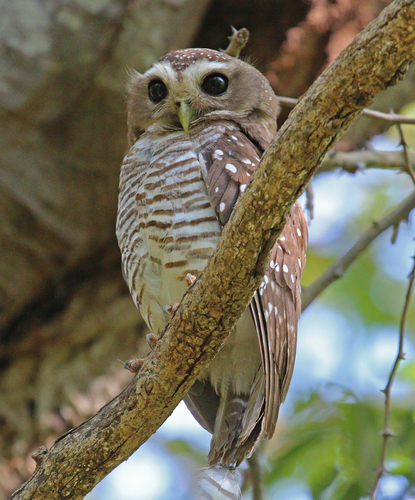
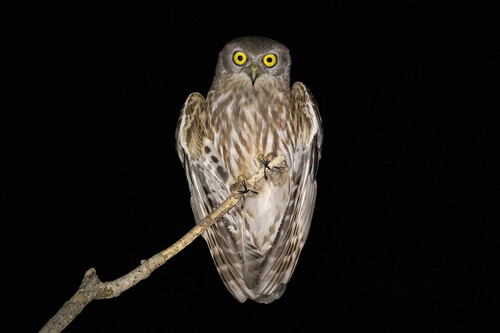
Scientific name: Ninox connivens (Latham, 1801). The barking owl has brown base plumage, with white spots on its wings and vertically streaked markings on its chest. It has large eyes with yellow irises, a distinct facial mask, and yellow skin on its feet. Its underparts are brownish-grey, with coarse white spotting, and its tail and flight feathers have prominent alternating brown and white bands. This is a robust, medium-sized owl species, with a body length of 39–44 cm (15–17 in), a wingspan of 85–120 cm (33–47 in), and a weight ranging from 380 to 960 g (13 to 34 oz). Size difference between male and female barking owls is very small; males are 8-10% heavier than females. This species is one of only a small number of owls that show standard sexual dimorphism. In a banding study carried out in the Pilliga forests of northern New South Wales, males had an average weight of 824 g (29.1 oz), while females averaged 745 g (26.3 oz). Across Australia, the smallest barking owls are found on Cape York Peninsula, and the largest are found in southern Australia. Barking owls live on mainland Australia, along the continent’s eastern and northern coasts, and in the southwest areas surrounding Perth, Western Australia. In inland areas, they occupy wooded environments, and areas close to lakes and waterways. They also live in the drier regions of New Guinea and the Moluccas, specifically on Halmahera, Morotai, Bacan and Obi. Once a widespread species, barking owls are now less common in southern mainland Australia. This species selects forests or woodlands that contain large trees suitable for nesting, and foliage cover for roosting. They often live near rivers, swamps or creek beds, because these areas typically have large hollow-bearing trees needed for nesting, and sufficient prey productivity to support the owls. All detailed existing studies of barking owl home ranges have taken place in southern Australia, where the species is declining. In northern Victoria, pairs of barking owls were found to have an average home range of 1,424 ha (3,520 acres), with very little overlap between the ranges of different pairs. Foraging activity was concentrated in the forested sections of each home range. These results match findings from the Pilliga forests of northern New South Wales, though home ranges in that region are larger, often reaching up to 2,500 ha (6,200 acres). While barking owls are uncommon, and sometimes even rare, in most suburban areas, they can occasionally become accustomed to humans, and even nest along streets or near farmhouses. The species is absent from most of Sydney, only occurring in scattered pockets of woodland on the northern beaches, and to the north and southwest of the Sydney region.