About Ninox boobook (Latham, 1801)
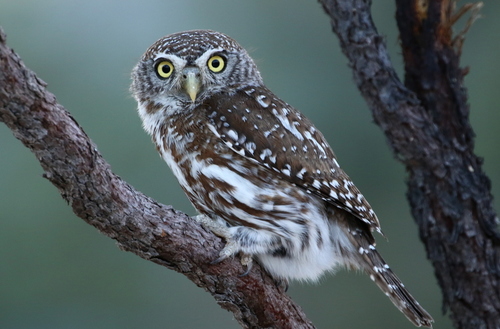
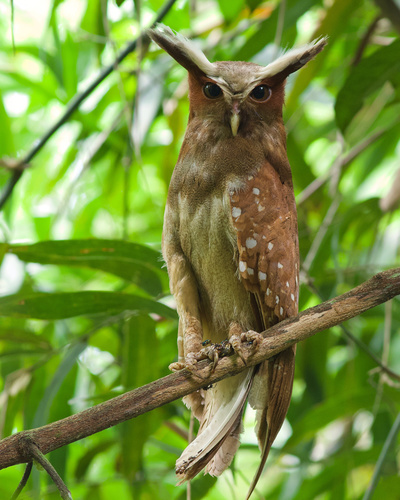
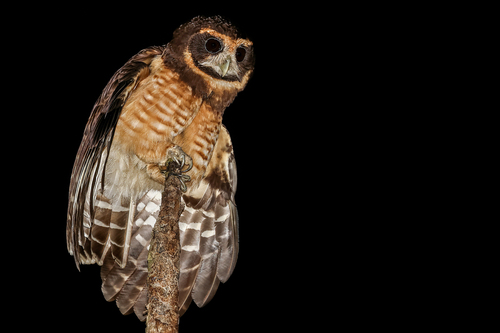
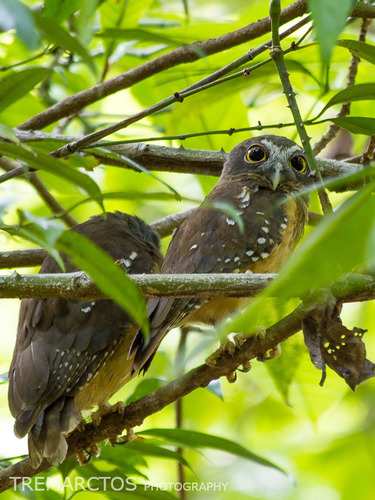
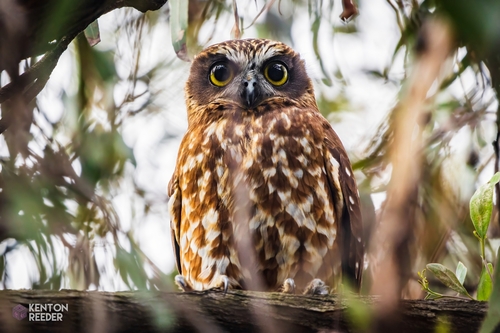
The Australian boobook, with the scientific name Ninox boobook (Latham, 1801), is the smallest owl species native to mainland Australia. Adults measure 27 to 36 cm (10.5 to 14 in) in total length, and the nominate subspecies is the largest of the subspecies. Mainland Australian Australian boobooks follow Bergmann's rule, meaning individuals from cooler, more southerly areas of their range are typically larger. For example, boobooks from the Canberra region weigh around 300 g (11 oz), while those from Cape York Peninsula and Broome weigh around 200 g (7.1 oz). Females are generally slightly larger and heavier than males: males weigh 146–360 g (5.1–12.7 oz) and females weigh 170–298 g (6.0–10.5 oz). This species has short, rounded wings, a short tail, and a compact silhouette when in flight. It lacks the ear tufts common in many other owl species. The Australian boobook generally has dark brown on its head and upperparts, with white markings on the scapulars and white spots on the wings. It has a paler facial disk, a white supercilium (eyebrow), and dark brown ear coverts and cheeks. Brown feathers on the upper forehead (above the supercilium) and the sides of the neck have yellow-brown highlights. Feathers on the lores, chin, and throat are white with black shafts. Underpart feathers are mostly brown with white spots and dark blue-grey bases. The upper tail is dark brown with lighter brown bars and a grey fringe at its tip, while the undertail is a lighter grey-brown. The underparts are overall pale, ranging from buff to cream, and are streaked with brown. Females are usually more prominently streaked overall than males, though this pattern is inconsistent and there is wide individual variation in plumage. Eyes have been recorded as grey-green, green-yellow, or light hazel. The bill is black with a pale blue-grey base and cere. Feet are greyish to pinkish brown, with dark grey to blackish claws. Overall plumage colour is highly variable and does not correspond to subspecies or geographic region. In northern and central Australia, researcher Mayr found that plumage colour correlates with rainfall or humidity: paler individuals occur in three separate disjunct areas (each around 1,600 km, or 990 mi, apart): western Kimberley and Pilbara, Sedan on the Cloncurry River, and the area around Ooldea. Darker individuals are found on Cape York and Melville Island. Young Australian boobooks are usually paler than adults, and do not develop full adult plumage until their third or fourth year of life. Juveniles under one year old have whitish underparts and foreneck, a larger more prominent pale eyebrow, and larger whitish spots on their upperparts. Their feather tips are white and fluffy, which are remnants of nestling down that wear away over time, persisting longest on the head. The feathers of the head, neck, and underparts are fluffier overall in juveniles. Immatures in their second and third year have plumage that more closely resembles adult plumage, though their crowns are paler and more heavily streaked. The Australian boobook is distributed across mainland Australia, but is scarce in more arid regions including western New South Wales, southwestern and western Queensland, most of inland South Australia away from the coast, and the interior of Western Australia and the Northern Territory. In drier areas, it is generally found along watercourses such as the Darling and Paroo Rivers, and in the Lake Eyre Basin. It also occurs on many offshore Australian islands including Groote Eylandt, Melville Island, Mornington Island in the Gulf of Carpentaria, and numerous islands off eastern Australia. Outside of Australia, it is found in southern New Guinea, Timor, and surrounding islands in Indonesia. It occupies a wide range of habitats, from forest and open woodland to scrubland and semidesert areas. In Australia, it mainly lives in eucalypt forests. It has adapted to human-altered landscapes, and can be found in farmland and suburban areas as long as some scattered trees are present.