About Nilssonia gangetica (Cuvier, 1825)
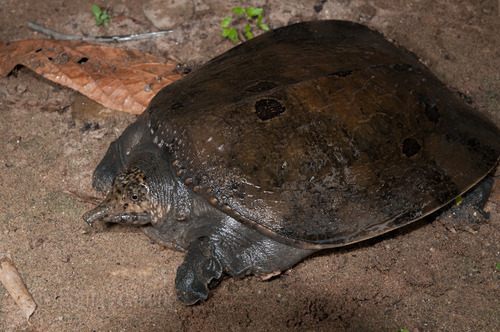
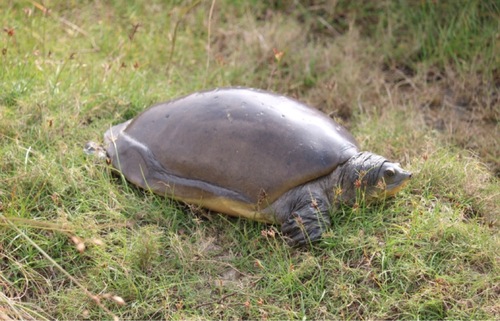
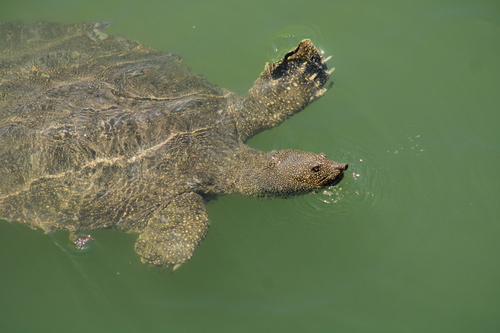
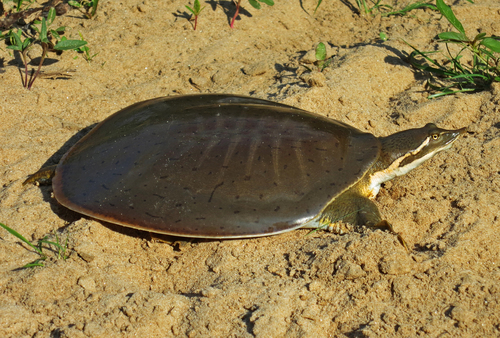
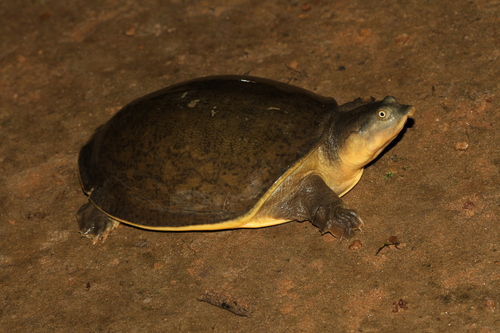
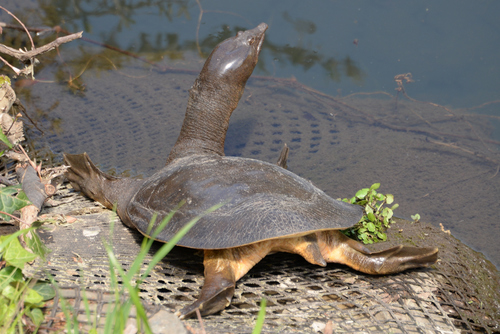
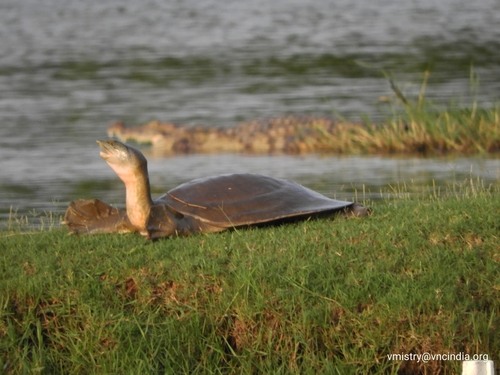
This species is identified based on the structure of its carapace and plastron. It has eight pairs of costal plates, with the last pair fully developed and in complete contact along the median line. There are two neurals between the first pair of costals, and the plates are coarsely pitted and vermiculate. The epiplastra are narrowly separated from each other in front of the entoplastron, which forms an obtuse or right angle. Plastral callosities are very large, present on the hyo-hypoplastral and xiphiplastral plates, and also present on the entoplastral plate in older specimens. The dorsal skin of young individuals has longitudinal ridges of small tubercles. The head is moderately sized; the snout (on the skull) is roughly as long as the diameter of the orbit. In adults, the interorbital region is considerably narrower than the nasal fossa. The postorbital arch measures between one third and one half of the greatest diameter of the orbit. The inner edge of the mandible is strongly raised to form a sharp ridge, which extends a short perpendicular process at the symphysis. The diameter of the mandible at the symphysis does not exceed the diameter of the orbit. The upper side of the turtle is olive-colored. The back of young individuals is vermiculated with fine black lines, and does not have ocelli. The head has a black longitudinal streak running from between the eyes to the nape, which is intersected by two or three inverted-V shaped black streaks. The lower parts of the body are yellowish. The length of the dorsal disk reaches 2 feet. This species occurs in the Indus, Ganges/Padma, Meghna, Brahmaputra, Jamuna, Narmada and Mahanadi basins, most of their tributaries, and intervening drainages, within the countries of Afghanistan, Bangladesh, India (including the states of Assam, Bihar, Gujarat, Jammu & Kashmir, Madhya Pradesh, Orissa, Punjab, Rajasthan, Uttar Pradesh and West Bengal), southern Nepal, and Pakistan.