About Nicrophorus quadripunctatus (Kraatz, 1877)
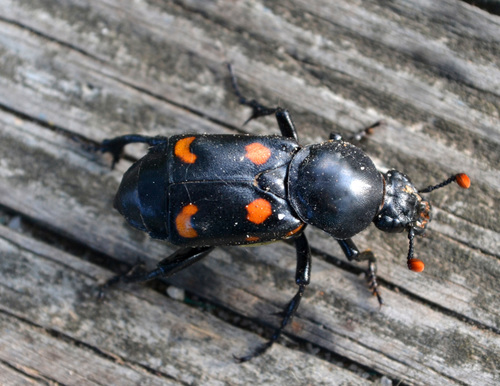
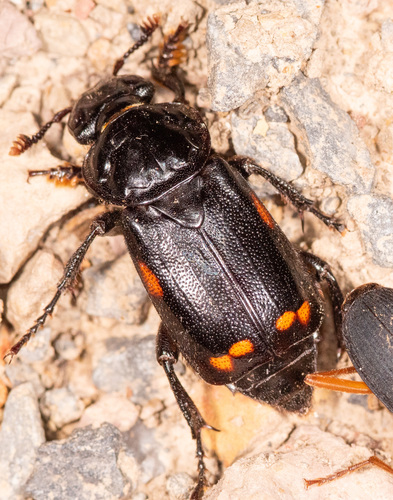
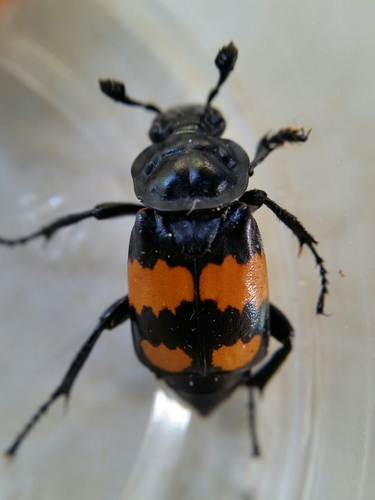
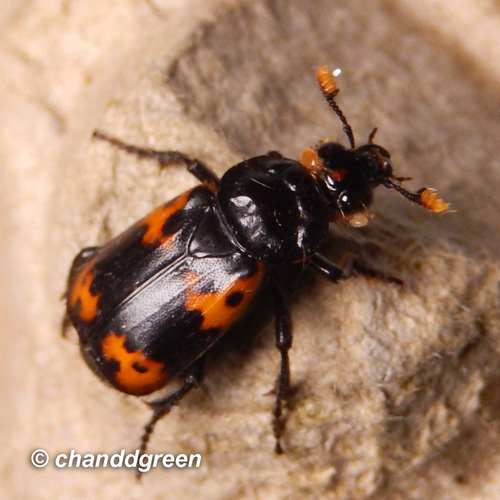
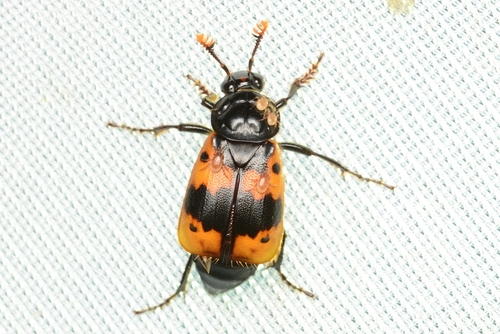
Nicrophorus quadripunctatus is a species of burying beetle that is most common in East Asia. It was first described by German entomologist Ernst Kraatz in 1877, and it has been the focus of a large amount of scientific research, especially research into its parental care behavior. Like other burying beetles, N. quadripunctatus lives on small vertebrate animal carcasses. This environment supplies all the nutrients that the beetles and their offspring need. To reduce the chance of resource theft and predation, the beetles bury the carcass underground. For extra protection, one dominant male-female pair cooperatively guards the buried carcass. Adult N. quadripunctatus have an average pronotum width of about 5 mm, and can be identified by horizontal red striping on their elytra. They have strong mandibles that can tear into carcasses, and a pair of antennae with chemoreceptors that they use to locate carrion. N. quadripunctatus has intrasexual competition for mates between members of the same sex for both males and females, and is typically monogamous. After mating, both parents provide care for the species' offspring. N. quadripunctatus has been spotted often in forest regions of Japan, South Korea, and eastern Russia, though it does not live only in these areas. The optimal temperature for reproduction in this beetle is around 20 °C, which matches the beetle's preferred climate. Temperatures of 25 °C or higher negatively affect the beetle's ability to lay eggs. N. quadripunctatus emerges above ground following a bimodal seasonal pattern, with distinct activity peaks in May and September. Most of this burying beetle's life is spent underground in its burrow with its carrion ball, either as a larva or as an adult raising its own larvae. The life cycle of N. quadripunctatus has five distinct stages. After a breeding pair finds and prepares a carrion source, the female lays her eggs nearby. The eggs hatch two days after being laid, and the larvae move to the carrion. Once inside the carcass, the developing young are called feeding larvae, and are cared for by their parents. After around six days, the young enter the post-feeding larval stage and move into nearby soil. They pupate in soil cells for approximately eight days, then shed their exoskeletons in a process called ecdysis. After ecdysis, N. quadripunctatus emerge from their soil cells as fully developed adult beetles, also called imago. The adults then move up through the soil to find new carrion, start their own families, and the life cycle begins again.