About Nicrophorus nepalensis (Hope, 1831)
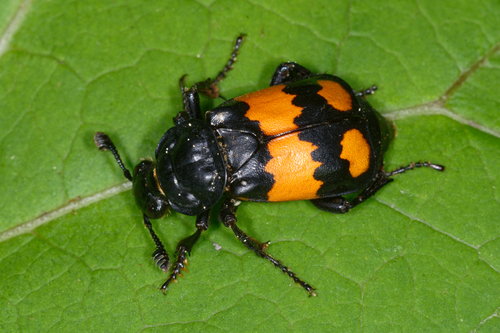
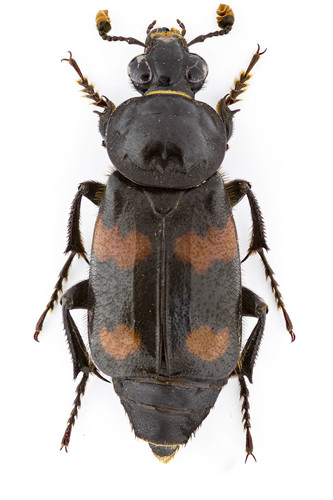
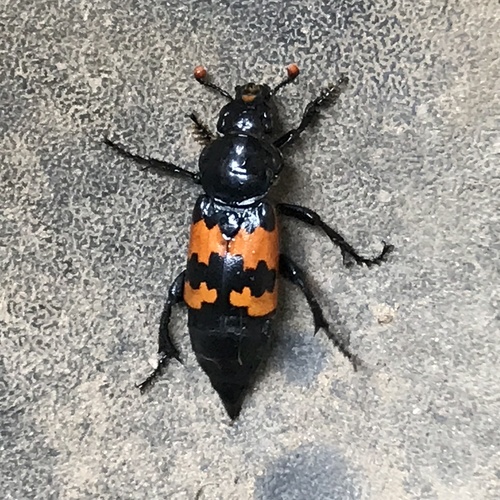
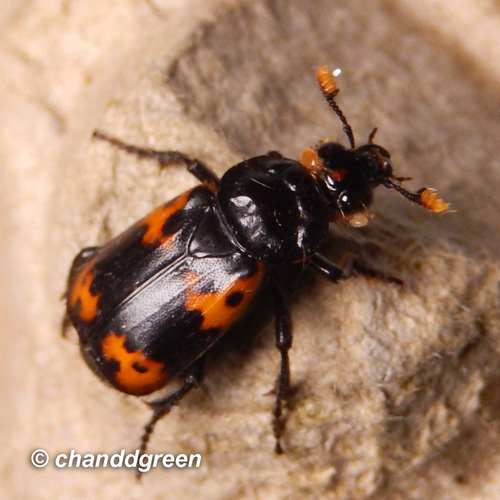
The body of Nicrophorus nepalensis is shiny black, with unique elytral patterns that feature four separate scalloped orange markings, plus black dots in both the anterior and posterior fascia. The basal segment of the antenna is black, and the tips are club-shaped, with three orange segments. Female frons have an elliptical shape, while male frons are more rectangular. Two distinct traits separate males and females: males have a conspicuous orange spot on the clypeus near the mandible, and males also have a post-ocular bulge. Pronotal width is the common measurement for beetle size; adult N. nepalensis range from 3.6 to 7.0 mm, with no significant size difference between males and females.
N. nepalensis is found primarily in mountainous regions of eastern Asia and the Malay Archipelago. Its distribution spans longitudinally from 73°E (Pakistan) to 149°E (Papua New Guinea), and latitudinally from 51°N (Ussuri, Russia) to 9°48′S (Papua New Guinea). Countries within this range are Pakistan, India, China, Laos, Burma, Thailand, Vietnam, Taiwan, Japan, the Philippines, and Malaysia.
N. nepalensis migrates along elevational gradients based on its thermal optimum and surrounding temperature. In most tropical areas, it occurs at cool, high elevations, but it can also be found at lower elevations due to its tolerance for warmer weather. When facing limited resources or competition from other insects or vertebrates, N. nepalensis will cooperate with other members of its own species to improve its chances of reproduction and survival. Group size varies with elevation and air temperature. Cooperative groups are thermal generalists that achieve high breeding success across all temperatures and elevations, while non-cooperative groups are thermal specialists that only breed well at intermediate temperatures and elevations.
N. nepalensis is carnivorous and feeds on the carcasses of small vertebrates such as rodents and birds. Carcasses are critical resources for reproduction, as the beetles lay eggs around a buried carcass for their larval broods to feed on. Fresh carcasses are rare in the wild because of intense competition from the same or different burying beetle species, blow flies, other invertebrates, and other mammals. N. nepalensis is one of the few beetle species that provides extensive biparental care: this includes defending larvae against competitors and regurgitating predigested carcass material to feed their young. N. nepalensis larvae go through three instar, or arthropod developmental, stages. After feeding on the carcass for approximately two weeks, third instar larvae leave the carcass crypt to prepare for pupation, and eventually metamorphose into adults.
N. nepalensis is often cited as an example of how unfavorable conditions promote cooperation in animal societies.