About Nicotiana tabacum L.
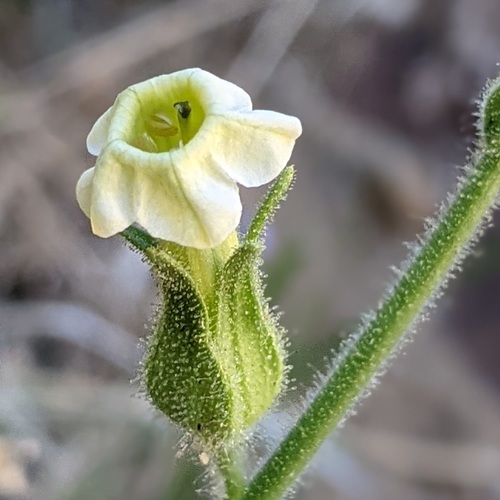
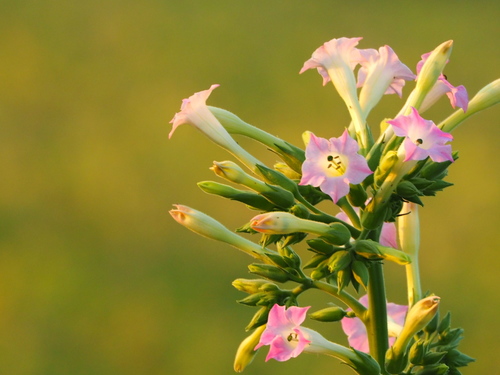
Nicotiana tabacum L. is an annual plant growing between 1 to 3 meters (3 to 10 feet) tall, with sticky hairs covering all its parts. Its stems are thick and not highly branched. Its leaves can reach over 50 centimeters (1 foot 8 inches) in length, with leaf blades ranging from ovate to elliptical or obovate, pointed at the tip, and either run down the stem at the base or are sessile (stem-clasping). It produces fragrant, multi-branched panicle inflorescences, with flower stalks measuring 5 to 15 millimeters (3⁄16 to 9⁄16 inches) long. The calyx is 12 to 18 millimeters (1⁄2 to 11⁄16 inches) long, with uneven, narrow, pointed calyx lobes that are 4 to 8 millimeters (3⁄16 to 5⁄16 inches) long and shorter than the calyx tube. The corolla has a plate-shaped limb, which can be white, pink, or red, while the corolla tube is greenish-cream, pink, or red. The total length of the corolla tube is 3.5 to 4.5 centimeters (1+3⁄8 to 1+3⁄4 inches), measuring 3 to 5 millimeters (1⁄8 to 3⁄16 inches) wide at the lower portion and widening to 7 to 12 millimeters (1⁄4 to 1⁄2 inch) at the upper portion. The corolla limb is lobed or pentagonal. Its stamens are unevenly sized and attached below the center of the corolla tube. The anthers of the four longer stamens lie near or slightly above the opening of the corolla tube, while the fifth stamen is noticeably shorter than both pairs of longer stamens. The stamens are 2.5 to 3.5 centimeters (1 to 1+3⁄8 inches) long, significantly longer than their anthers, and are hairy at the base. The fruit is a narrowly elliptical to egg-shaped capsule 1.5 to 2 centimeters (9⁄16 to 13⁄16 inches) long, which may extend beyond the calyx or be enclosed by it. Its seeds are spherical or broadly elliptical, up to 0.5 millimeters (1⁄64 inch) long, with a wavy, net-like surface. Nearly every part of the plant except the seeds contains nicotine, with concentration varying based on factors like species, soil type, cultivation practices, and weather conditions. Nicotine concentration increases as the plant ages. Tobacco leaves contain 2 to 8% nicotine, bound as malate or citrate. The distribution of nicotine in a mature plant varies widely: 64% of total nicotine is found in the leaves, 18% in the stem, 13% in the root, and 5% in the flowers. N. tabacum is native to tropical and subtropical America and can also grow as a weed. It is sensitive to temperature, air humidity, soil humidity, and soil type. Optimal growing conditions include temperatures of 20–30 °C (68–86 °F), atmospheric humidity of 80 to 85%, and soil without high nitrogen levels. The plant is native to the Caribbean, where the Taíno people were the first recorded group to use and cultivate it. In 1560, Jean Nicot de Villemain, then French ambassador to Portugal, brought tobacco seeds and leaves to the French court as a "wonder drug". In 1586, botanist Jaques Dalechamps named the plant Herba nicotiana, a name that was later adopted by Linnaeus. It was first grown as an ornamental plant, then considered a cure-all, before becoming a common plant used for snuff and tobacco. Tobacco was introduced to Africa in the early 17th century. Leaf extract was a popular pest control method until the early 20th century. In 1851, Belgian chemist Jean Stas documented the use of tobacco extract as a murder poison, when Belgian count Hippolyte Visart de Bocarmé poisoned his brother-in-law with tobacco leaf extract to obtain urgently needed money. This case provided the first exact proof of alkaloids in forensic medicine. Today, N. tabacum is commercially cultivated worldwide. All parts of the plant contain nicotine, which can be extracted and used as an insecticide. Dried leaves can also be used for this purpose and remain effective for 6 months after drying. Leaf juice can be rubbed on the body as an insect repellent. Dried leaves can be chewed as an intoxicant, used as snuff, or smoked. It is the main species used to make cigarettes, cigars, and other tobacco products. A drying oil can be obtained from its seeds, and some varieties are cultivated as ornamental plants. There are recorded ethnomedicinal uses of this plant across multiple regions: In Brazil, leaf juice is taken orally to induce vomiting and narcosis. In Colombia, fresh leaves are used as a poultice on boils and infected wounds; crushed leaves mixed with palm oil are used as a hair treatment to prevent baldness. In Cuba, leaf extract is taken orally to treat dysmenorrhea. In East Africa, dried leaves of Nicotiana tabacum and Securinega virosa are mixed into a paste and applied externally to kill worms in sores. In Ecuador, leaf juice is used to treat indisposition, chills, snake bites, and pulmonary ailments. In Fiji, fresh root is taken orally for asthma and indigestion; fresh root juice is used as eye drops for bloodshot eyes and other eye problems; seeds are taken orally to treat rheumatism and hoarseness. In Guatemala, leaves are applied externally by adults to treat myiasis, headaches, and wounds; a hot water extract of dried leaves is applied externally for ringworm, fungal skin diseases, wounds, ulcers, bruises, sores, mouth lesions, stomatitis, and mucous membrane issues; leaves are taken orally for kidney diseases. In Haiti, a decoction of dried leaves is taken orally for bronchitis and pneumonia. In Hong Kong and other parts of China, mashed fresh leaves mixed with vegetable oil are applied to injuries to speed healing. In Iran, an infusion of dried leaves is applied externally as an insect repellent; ointments made from crushed leaves are used to treat baldness, dermatitis, infectious ulceration, and as a pediculicide. In southeastern Mexico, the ancient Maya considered Nicotiana a sacred plant closely linked to earth and sky deities, used for visionary and therapeutic purposes. Contemporary Tzeltal and Tzotzil Maya of Highland Chiapas preserve this tradition, viewing the entire tobacco plant as a primordial medicine and powerful botanical helper or protector. Depending on the condition being treated, whole Nicotiana leaves are used alone or with other herbs to make medicinal plasters and teas. The most common preparation is fresh or green leaves ground with slaked lime to make an intoxicating oral snuff used for both protection and therapy. In the United States, extract of N. tabacum is taken orally to treat tiredness, ward off disease, and calm fear. In Tanzania, leaves of Nicotiana tabacum are inserted into the vagina to stimulate labor. In Zimbabwe, an infusion of leaves or root is taken orally for asthma and other respiratory problems; leaves and roots are also rubbed on warts and wounds as an ointment.