About Nicandra physalodes (L.) Gaertn.
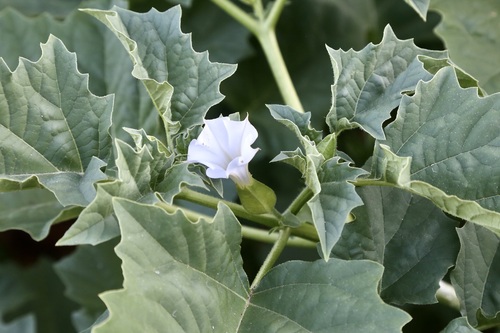
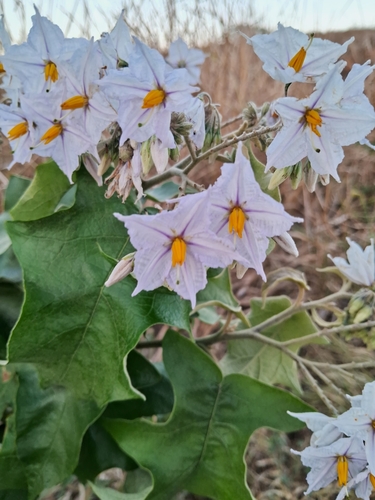
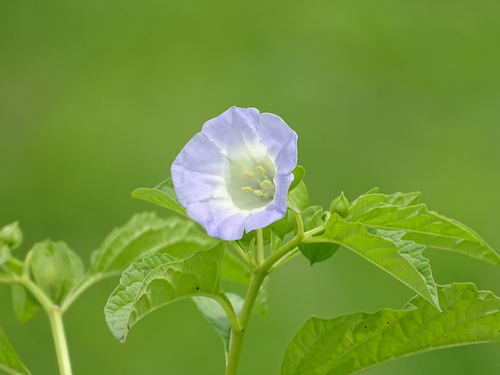
Nicandra physalodes is an annual species that grows up to 1 metre tall, with spreading branches and ovate, mid-green, toothed and waved leaves. Its flowers are bell-shaped, 5 centimeters or more across, pale violet with white throats (occasionally pure white), and open only for a few hours during the day. Toward the end of its blooming period, the flower develops a lantern-like shape; the inflated calyces somewhat resemble those of certain Physalis species. Unlike the single, undivided, bladder-like fruiting calyx of Physalis, the fruiting calyx of Nicandra is deeply lobed, with cordate sepals. This plant is thought to have insect repellent properties, particularly against whitefly. N. physalodes seeds have a relatively thick seed coat (testa) and exhibit strong dormancy, which can be broken by a combination of warm and cold stratification involving temperature fluctuations between 15 and 25 °C.
Nicandra physalodes is native to western South America: Northwest Argentina, Bolivia, North and Central Chile, and Peru. It has been introduced to many tropical and temperate regions worldwide, and is an arable land weed across almost the entire globe. In the British Isles, it is a frequent casual plant found in bare or sparsely grassy areas, including cultivated ground, waste places, and rubbish tips. Its presence there can often be traced to seeds contained in commercial bird seed mixes.
Nicandra physalodes is suspected to have poisonous properties similar to those of certain Physalis species that have been implicated in sheep poisoning. Conflicting evidence about these suspicions comes from Australia, where the plant is sometimes called wild gooseberry. It has been suspected of poisoning livestock at various times based on rather vague evidence, but a feeding test using a sheep and a goat carried out in New South Wales returned negative results. In 1970, a case was reported from New South Wales where two crossbred ewes died, apparently from consuming this plant. The ewes had been grazing in a paddock of Wimmera ryegrass heavily infested with 60 cm tall Nicandra physalodes plants that grew taller than the ryegrass. Both ewes died with symptoms of bloat within 12 hours. Necropsy found extensive hemorrhages in the heart and lungs, but no other apparent abnormalities, and the paunches of the ewes contained large amounts of Nicandra.
Existing literature holds conflicting accounts of the uses of this plant, describing it as both edible and toxic/medicinal, leading to the conclusion that it should be considered suspect and treated with caution. The whole plant is said to be toxic (some sources even describe it as very toxic), and is used medicinally as a diuretic, sedative, and cough medicine. Tender leaves have occasionally been cooked and eaten as a leaf vegetable or pot herb, for example in Tanzanian cuisine. A leaf decoction has been used as an insecticide to treat head lice, while fresh leaf juice has been used to treat amoebiasis. Unspecified medicinal uses of the leaves have also been recorded in the folk medicine of Brazil and Madagascar. The dry brown berries inside the papery calyces have an odour similar to cooking oil; while at least one source describes them as poisonous, they are eaten by the Raji people of Nepal. The seeds are said to be edible, but are also used as an insecticide and medicinally as an antipyretic. Boiled in water, they are taken for fever, indigestion, and constipation, which further implies they have laxative properties.
In traditional Tibetan medicine, the seeds are described as having an acrid taste and possessing 'a cooling, very poisonous potency' that produces analgesic, anthelmintic, antibiotic, anti-inflammatory, and antipyretic effects. They are also used to treat toothache, impotence, and unspecified 'contagious disorders', and are said to 'increase bodily vigour' (act as an adaptogen) when consumed in regular doses. Nicandra physalodes is used as a folk remedy in several Himalayan countries and regions, including Himachal Pradesh, Uttar Pradesh, Nepal, and Sikkim, despite not being native to the region. This likely stems from popular recognition of its familial resemblance (particularly in its inflated fruiting calyces) to several native Himalayan solanaceous plants that have long been used in traditional medicine, from the genera Anisodus, Physochlaina, Przewalskia, and Scopolia, all belonging to tribe Hyoscyameae of subfamily Solanoideae. The highly valued (and consequently over-harvested) species Anisodus tanguticus is particularly relevant in this context.
For at least a century, Nicandra seeds have been used in southwestern China to make the jelly for the dessert called bingfen (Chinese: 冰粉; pinyin: bīngfěn; literal translation: iced rice noodles), which is usually known in the west as crystal jelly or ice jelly, and is said to have been invented during the Qing dynasty. To prepare the jelly, a quantity of the small, plump, brown seeds are placed in a cheesecloth envelope, soaked for a time, then scrubbed vigorously in a bowl of mineral water to release the pectin they contain. Slaked lime is then stirred into the pectin-rich solution, which causes it to set into a delicate, yellowish jelly with a neutral flavour after a few hours. This gelatinous product is enjoyed not for its taste, but for its intriguing and pleasant texture, and acts as a 'blank canvas' for a variety of flavourings, most notably local unrefined brown sugar syrup with a molasses-like taste. Desserts made with crystal jelly are particularly popular in Chengdu, where they are valued for cooling relief from the humid summer heat, and for the cooling contrast they provide to the often highly-spiced local Sichuan cuisine. In the southern United States, plant juice has been mixed with milk to make poisoned bait for houseflies and blow flies, similar to how crumbled caps of the fungus Amanita muscaria were used in parts of Europe. Unlike the mushroom/milk infusion that only stupefies flies, this bait kills flies outright.