About Nettapus coromandelianus (J.F.Gmelin, 1789)
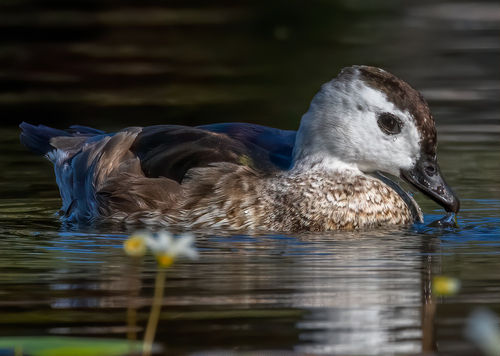
This species, known scientifically as Nettapus coromandelianus (J.F.Gmelin, 1789), includes the smallest waterfowl individuals on Earth, which can weigh as little as 160 g (5.6 oz) and measure 26 cm (10 in) in length. It has a short, goose-like bill that is deep at the base. Males have a dark brown forehead and crown, plus a broad blackish green collar at the base of the neck. The sides of the head and neck are whitish, while the back, wing coverts, and scapulars are dark brown with a green and purple gloss. Females have a duller cap, a brown line running through the eye; their male-typical collar is replaced by spots, and their face is flecked while their neck is finely vermiculated, which differs from male plumage. Non-breeding (eclipse) males resemble females, but they have a broader white wing band. In flight, males have dark wings with white flight feathers tipped in black. Females have dark wings, with a white trailing edge on the secondaries and a few inner primaries. All members of this species have a red iris, black legs (which are greenish in breeding males), and a black bill. The hind toe is narrowly lobed. The nostril is small and oval, opening close to the base of the bill's commissure. Downy chicks have white superciliary stripes that meet at the back of the black head. A short dark eye stripe is present on their whitish face. The upperside of the chick's neck is grey, the mantle is grey brown, and two white patches are found on the scapulars. The chick's tail is dark grey to black, and its underside is buff. This species is widely distributed across Asia, with its range extending into Australia. Populations move in response to rain and water availability. Some populations disperse further in summer, and are found only seasonally—this is the case in Afghanistan, for example. Winter dispersal is also wide-ranging: individuals have been observed as far west as Arabia and Jordan, and they are regularly found on regional islands including the Maldives and the Andamans. They inhabit particularly lakes and ponds with emergent vegetation, where they forage. They can even be found in small village ponds in South Asia. In Australia, they mainly inhabit lagoons. They are reported to roost on trees. Multiple pairs of this species may forage in close proximity on a single waterbody. Large flocks form during winter, and a flock of nearly 6000 individuals has been recorded at Chilka lake. This species feeds mainly at the water surface. Stomach analysis has shown they eat small fish of the genera Puntius, Mystus, and Oryzias, as well as molluscs, crustaceans, insect larvae, and plant matter from genera including Ipomoea, Hydrilla, and Ruppia. They do not dive or up-end to feed, and they take flight directly from the water surface without needing to run or patter on the surface first. They fly swiftly, often low over water, and are agile enough to escape falcons.