About Nestor notabilis Gould, 1856
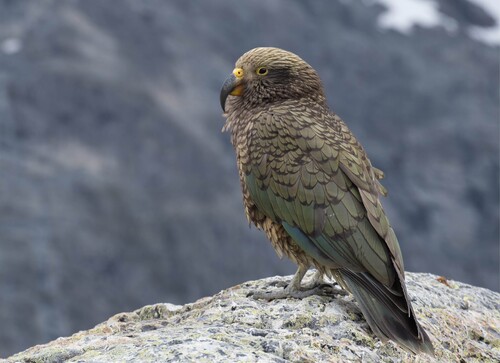
Description: The kea is a large parrot with a total length of 46 to 50 cm (18 to 20 in), and some individual specimens may reach up to 55 cm (22 in). Adult kea weigh between 750 and 1,000 g (1.65 and 2.20 lb); males have an average weight of 956 g (2.108 lb), while females average 779 g (1.717 lb). One source records the overall mean adult weight as 922 g (2.033 lb). Its plumage is mostly olive-green, and it has a grey beak with a long, narrow, curved upper mandible. Adult kea have dark-brown irises, and grey cere, eyerings, and legs. Orange feathers grow on the undersides of their wings. Feathers on the sides of the face are dark olive-brown, feathers on the back and rump are orange-red, and some of the outer wing feathers are dull blue. It has a short, broad, bluish-green tail with a black tip. Feather shafts project out from the tip of the tail, and the undersides of the inner tail feathers bear yellow-orange transverse stripes. Males are approximately 5% longer overall than females, and the male's upper beak is 12–14% longer than that of the female. Juveniles generally look similar to adults, but they have yellow eyerings and cere, an orange-yellow lower beak, and grey-yellow legs. Distribution and habitat: The kea is one of nine living endemic parrot species native to New Zealand. Its current range extends from lowland river valleys and coastal forests of the South Island's west coast up to alpine regions of the South Island, including Arthur's Pass and Aoraki / Mount Cook National Park. Throughout its entire current range, the kea is closely associated with southern beech (Nothofagus) forests along the alpine ridge. Today, apart from occasional stray individual vagrants, kea are not found in the North Island. Subfossil kea bones have been discovered in sand dunes at Mataikona in eastern Wairarapa, Poukawa near Hastings, and Waitomo. These remains show that kea once ranged across lowland forests over most of the North Island until Polynesian settlers arrived approximately 750 years ago. Kea subfossils are not limited to alpine areas, and are commonly found at lowland or coastal sites in the South Island. The kea's current distribution reflects the impact of mammalian predators, including humans, that drove the species out of lowland forests and into mountain habitats.