About Nestor meridionalis (Gmelin, 1788)
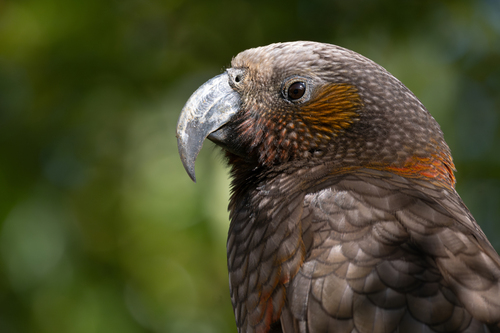
The New Zealand kākā, scientifically named Nestor meridionalis (Gmelin, 1788), is a medium-sized parrot. It measures 45 cm (18 in) long and weighs between 390 to 560 g (14 to 20 oz), with an average weight of 452 g (0.996 lb). It is closely related to the kea, but has darker plumage and is more arboreal. Its forehead and crown are greyish-white, and its nape is greyish brown. The neck and abdomen are more reddish, while the wings are more brownish. Both subspecies have strongly patterned brown/green/grey plumage, with orange and scarlet patches under the wings. Color variants with red to yellow coloring, especially on the breast, are sometimes seen. Its calls include a harsh "ka-aa" and a whistling "u-wiia". The kākā's beak structure differs slightly from its closest relatives: the kea and the kākāpō. The kākā's upper beak, called the rhinotheca, is narrower and slightly longer than that of the kākāpō. However, it is not as long or sharp as the rhinotheca of the kea. This places the kākā's bill between that of the kea and kākāpō in length, sharpness, and width. There is evidence of sexual dimorphism in North Island kākā, where males tend to have larger bills than females. On average, male culmen lengths are 13.6% and 12.4% larger than female culmen lengths. This trait is thought to have evolved in male kākā because males must provision most of the food for females and hatchlings during the breeding season. A larger culmen is needed to access food sources like wood-boring larvae, which only males tend to forage for. The New Zealand kākā inhabits lowland and mid-altitude native forest, preferring mature native forests with a more complex canopy. It was once widespread across most of New Zealand, but its distribution has shrunk significantly due to habitat modification, predation, and resource competition from introduced animals. Today, its main strongholds are the offshore reserves of Kapiti Island, Codfish Island / Whenua Hou, and Little Barrier Island. As of 2021, less than 50% of the kākā population lives on the New Zealand mainland. The species is breeding rapidly at the mainland island sanctuary at Zealandia, where over 800 birds have been banded since their reintroduction in 2002. Since their 2002 reintroduction, North Island kākā have continued to recolonize the Wellington area. A 2015 report recorded a significant increase in their numbers over the preceding 12 years.