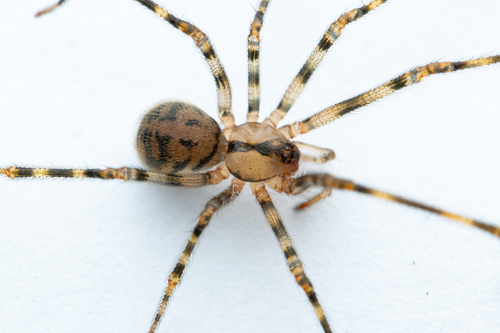
About Nesticus cellulanus (Clerck, 1757)
Nesticus cellulanus (Clerck, 1757) is a spider species that closely resembles members of the Theridiidae family, and even bears a comb on its fourth tarsi. Adult males have a body length of 3–5 mm (0.12–0.20 in), while adult females measure 3.5–6 mm (0.14–0.24 in). Aside from this small difference in size, the two sexes are very similar in general appearance. The carapace is pale yellow, marked with a dark brown median band that narrows toward the middle, plus thin dark lines along its margins. The abdomen is also pale yellow, with three or four dark rings on either side of an irregular median band. The legs share the same pale yellow coloration as the carapace, and sometimes carry dark annulations. The color of this species' markings varies with the light level of its habitat: darker habitats produce lighter markings. This species has a Holarctic distribution, found across Europe and Turkey, and has been introduced to northeastern United States and Canada. It lives primarily in damp, dark habitats including caves, mines, cellars, sewers, and hollow trees. In these locations, it builds a web similar to that of steatoda spiders: a loose platform of sticky threads that traps crawling insects. Mating occurs in early summer, and females produce egg sacs between June and August; adults can be found year-round. Courtship begins when the male makes contact with the female's silk thread. Initially, courtship involves gentle knocking with the male's pedipalps and jerking movements of the abdomen. This activity increases in intensity until copulation begins, and may even cause partial destruction of the female's web. The female eventually turns toward the male and suspends herself vertically, after which the male pushes his conductor into the female's insemination orifice. After the male withdraws his first palpal bulb, he may attempt a second insertion with the other bulb after repeating his palpal knocking. The spiders separate peacefully once copulation is complete. Eggs are laid between 34 and 54 days after copulation, and spiderlings hatch 25 to 28 days after laying. Newly-moulted females do not respond to a male's courtship, while already inseminated females react aggressively by rushing toward the male.

