About Nesoptilotis leucotis (Latham, 1801)
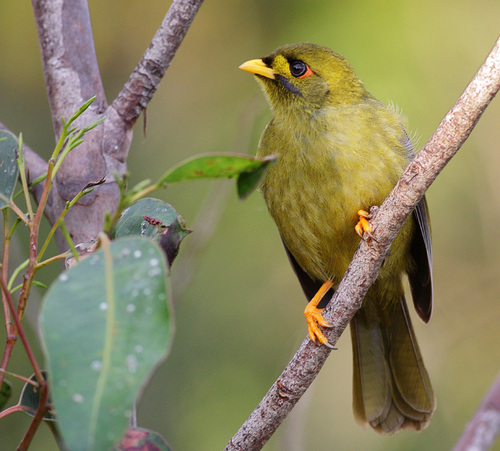
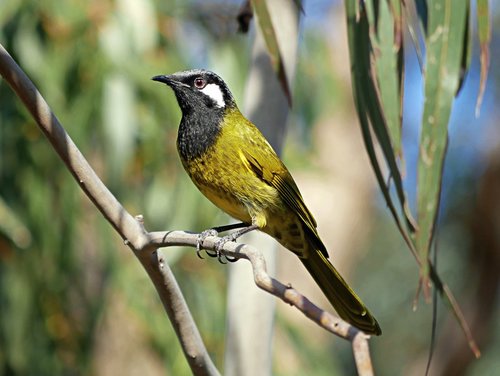
The white-eared honeyeater (Nesoptilotis leucotis) has an olive-green upper and lower body, with wings and tail that mix brown, yellow, and olive. It has a dark grey crown marked with black streaks, black cheeks and throat, and white ear-coverts. Its iris is red or brown (brown in juveniles), it has a black bill, and dark grey legs. This is a medium-sized honeyeater, measuring 19–22 centimetres (7.5–8.7 in) in total length. The species shows no sexual dimorphism, meaning males and females have identical appearance. On average, individuals weigh approximately 20 g (0.71 oz), and have a beak length of around 17 mm (0.67 in).
The white-eared honeyeater’s preferred habitats include forests, woodlands, heathlands, mallee, and dry inland scrublands. The most important habitat features for this species are a eucalyptus canopy, rough bark, and a shrub layer. The eucalyptus canopy provides nectar during spring, the rough bark supports insects year-round, and the shrub layer is used for nesting and shelter. The species prefers mature vegetation that has a dense understory. It is relatively unselective in terms of floral and structural habitat characteristics, and can be found in many different forest and woodland types, in both edge and interior habitats. It can even occupy small woodland patches smaller than 2 hectares. Habitats this species avoids are heavily degraded areas, recently burnt areas, and areas with little to no understory.
White-eared honeyeaters feed on both nectar and insects. Though they are often categorized as nectarivores, they consume insects in equal proportion to nectar. They feed primarily on nectar during spring and summer (from August to December), and switch to feeding mostly on insects for the rest of the year. They actively probe for insects on tree trunks and branches, and prefer trees with soft, peeling, or flaking bark that often hold insects. They mostly eat termites and spiders, but will also feed on lerp and honeydew produced by insects. When foraging for insect prey, the white-eared honeyeater searches intensively, capturing an average of one insect every 5 seconds. This high-volume foraging approach suggests the insects it eats are low in nutritional value.
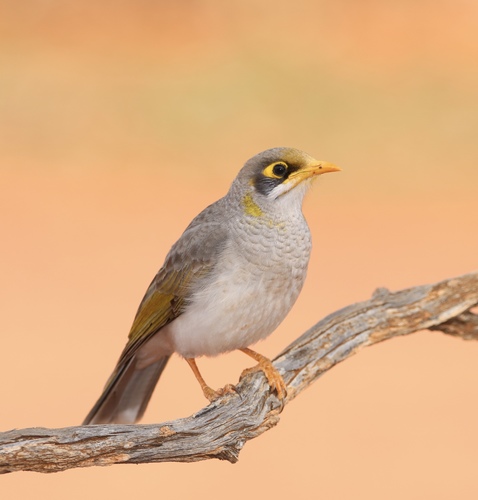
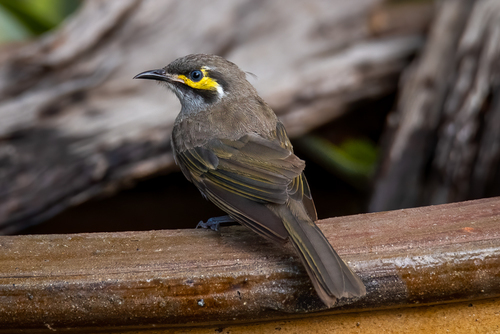
Obligate nectarivores compete strongly with white-eared honeyeaters for the highest quality nectar resources, while obligate insectivores compete for the highest quality insect resources. This competition forces the white-eared honeyeater to use alternative food sources, such as smaller or better-hidden insects. The yellow-faced honeyeater (Caligavis chrysops) shares a similar feeding strategy with the white-eared honeyeater, and aggressive behaviour from yellow-faced honeyeaters directed at white-eared honeyeaters has been observed.