About Nesoenas mayeri (Prévost, 1843)
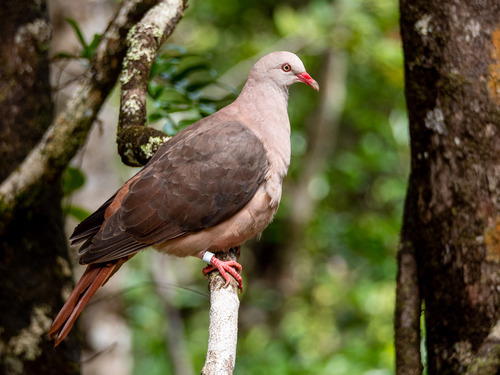
This species, the pink pigeon, has the scientific name Nesoenas mayeri (Prévost, 1843). An adult pink pigeon measures approximately 36–38 centimetres (14–15 inches) from beak to tail and weighs 350 grams. Adults have pale pinkish-grey plumage on their head, shoulders and underside, along with pink feet. Their beak is dark pink with a white tip. They have dark brown wings and a broad, rust-colored tail. Their dark brown eyes are surrounded by a red skin eye-ring. Newly hatched pink pigeons have sparse, downy-white feathers and closed eyes. The pink pigeon's flight call is a short, hardened "hoo hoo". The territorial call of a male pink pigeon is a series of coos. This species is endemic to the Mascarene island of Mauritius, a small Indian Ocean island east of Madagascar, and the small predator-free Île aux Aigrettes, located off Mauritius' eastern coast. An extinct subspecies, the Réunion pink pigeon, lived on neighboring Reunion Island before dying out around 1700. As of 2016, five wild pink pigeon populations exist: four are located within Black River Gorges National Park, and the fifth is on Isle aux Aigrettes. All populations are monitored by the Mauritian Wildlife Foundation. The pink pigeon is not migratory. It prefers upland evergreen forests, but also lives comfortably in coastal forests as long as the vegetation is native, and the area is not dominated by introduced species such as Chinese Guava (Psidium cattleianum) or privet (Ligustrum robustum). Destruction of this native old-growth forest has been a major driver of the species' population decline. The pink pigeon's breeding season typically starts in August to September, though individual birds may breed year-round. Males court females with a "step and bow" display. Mating is generally monogamous, and pink pigeons usually mate for life. Breeding pairs build a flimsy platform nest and defend a small territory around it, even though the species originally had no natural predators, as pairs must compete for territory with other breeding pairs. The female usually lays two white eggs, and incubation lasts two weeks. Males incubate eggs during the day, while females incubate at night and early in the morning. Pink pigeons may breed often, laying five to 10 eggs in a single breeding season; breeding only pauses in the wild when birds molt, which can be a full molt or a partial molt of the body or head. Pink pigeon populations have more males than females. This is because males have a life expectancy around five years longer than females, and wild females face a higher risk of predation. The longer lifespan difference also stems from the high metabolic cost of egg production: females produce eggs almost constantly, even when eggs are unfertilized similar to domestic chickens, and this ongoing cost reduces female survival. In captivity, males remain fertile until they reach 17–18 years of age, while females remain fertile until 10–11 years of age. For newly hatched chicks: from 1 to 7 days old, chicks have closed eyes and are fed entirely on crop milk. From 7 to 10 days old, chicks transition to eating solid food. From 2 to 4 weeks old, chicks fledge but still receive food from their parents. From 4 to 6 or 7 weeks old, chicks stay in the nest. After this period, chicks leave the nest.