About Nerodia rhombifer (Hallowell, 1852)
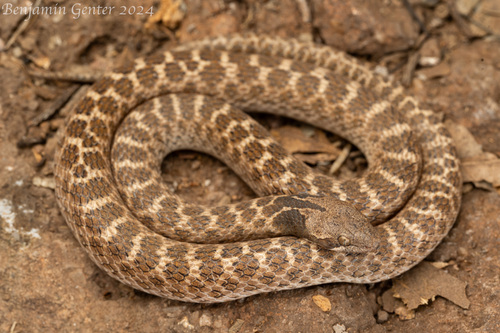
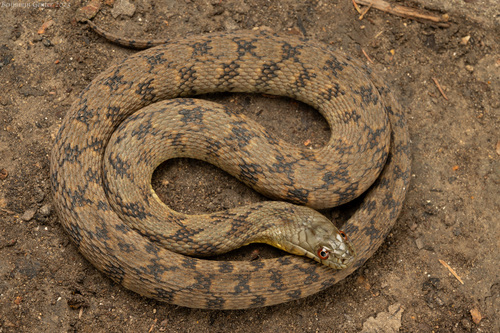
The diamondback water snake, Nerodia rhombifer, is predominantly brown, dark brown, or dark olive green, with a black net-like pattern along its back where each spot is vaguely diamond-shaped. Dark vertical bars and lighter coloring are often present down the snake's sides. Following typical counter-coloration, its underside is generally yellow or lighter brown, and often marked with black blotching. Its dorsal scales are heavily keeled, which gives the snake a rough texture. At midbody, the dorsal scales are arranged in 25 or 27 rows. The species usually has 3 postocular scales. Adult males have multiple papillae (called tubercles) on the underside of the chin, a trait not found in any other snake species native to the United States. Nerodia rhombifer reaches an average total length (including the tail) of 76–122 cm (30–48 inches), with a record maximum total length of 180 cm (69 inches). Newly born juveniles (neonates) are often lighter in color, making their patterns more distinct; individuals darken as they age. The diamondback water snake is one of the most common snake species within its native range. It lives predominantly near slow-moving bodies of water including streams, rivers, ponds, and swamps. The native geographic range of the diamondback water snake covers the central United States, predominantly along the Mississippi River valley, though its range extends beyond this valley. It can be found in the U.S. states of Texas, Oklahoma, Kansas, Iowa, Louisiana, Arkansas, Missouri, Illinois, Indiana, Tennessee, Mississippi, Georgia, and Alabama. It is also found in northern Mexico, in the states of Coahuila, Nuevo León, Tamaulipas, and Veracruz. This snake has been introduced to Lafayette Reservoir in Contra Costa County, California. It was first observed there in the late 1980s, and reached high population densities by the early 1990s. This led to complaints from fishermen and other visitors, who believed the snakes were eating the reservoir's fish, frogs, and turtles—mostly stocked fish, American bullfrogs, and red-eared sliders, all of which are also non-native species. In 1996, a contract was awarded to a wildlife control company to cull the snake population. Just as the control effort began in late 1997, large numbers of dead watersnakes and turtles were observed. The exact cause of the die-off is unknown, but a respiratory tract fungus was found in snakes that were dissected. The outbreak may have been caused by an abnormally wet and cold El Niño weather system. There have been no confirmed observations of diamondback water snakes at Lafayette Reservoir since late 1999, but occasional unconfirmed sightings are still reported, and a low-density population may still persist there. Like other species in the Nerodia genus, the diamondback water snake is ovoviviparous. Adults breed in the spring, and gravid females give birth in late summer or early fall. Neonates measure around 20–25 cm (8–10 inches) in length. Although the species' range overlaps with several other water snake species, interbreeding is not known to occur. It is one of the only known species capable of asexual reproduction.