About Neptis nata Moore, 1857
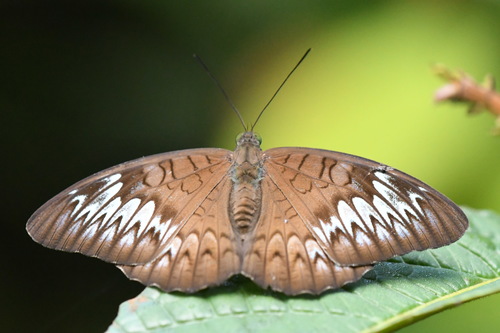
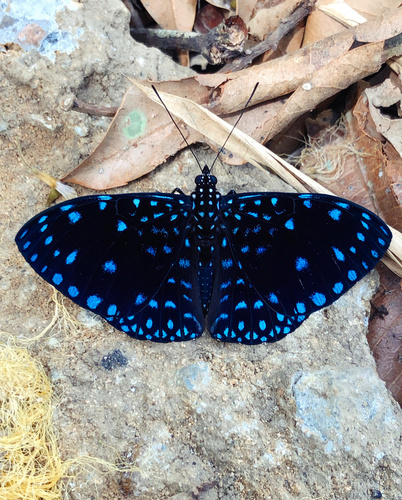
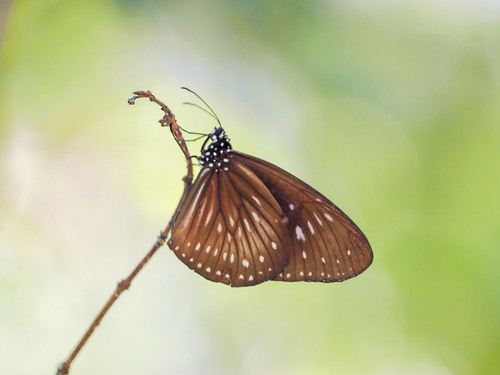
This description covers the dry-season brood of Neptis nata, for both male and female individuals. On the upperside, the base color is deep purplish black. All markings are bluish-white, very prominent, and have sharply defined edges; the cilia are alternating with white. On the forewing, the cell streak is broadly truncate at its end, and the broad discocellular spot beyond it is elongated to an acute point. There is a curved discal series of moderately sized spots: the subapical spots are rather elongated and oval, the lower four are arranged in a linear oblique line, the uppermost spot is small, oval, and positioned very close to the submarginal lunules, the two lowest spots are the smallest and narrowest, while the second spot from the bottom is broad. There is also a submarginal row of small white lunular spots, which are narrowest in females, an inner submarginal slender, sinuous, obscure pale line, and an obscure marginal lunular line. On the hindwing, there is a somewhat narrow inner discal band that ends at the upper subcostal vein, and a narrower outer discal macular band; there is also an obscure, pale, slender medial-discal lunular line, and an even marginal line. In males, the base of the costa is broadly glossy silvery-grey, with a duller grey patch of scales positioned medially, extending from the costal vein to below the base of the radial vein. The underside is dusky olive-tinted purplish-brown. Markings follow the same pattern as the upperside and are all prominent bluish-white, with exceptions: the inner and outer marginal lines of the forewing, the medial-discal and marginal lines of the hindwing, and the two basal streaks of the hindwing are lilacine grey. The body and palpi are black on the upperside, and the thorax is iridescent; the abdomen has a faint bluish-grey band at its base on the upperside. The palpi and thorax on the underside, as well as the forelegs, and the middle and hind femora are bluish-grey; the abdomen on the underside, and the middle and hind tibiae and tarsi are pale ochreous brown. For the wet-season brood, all upperside markings are somewhat narrower. The underside ground color is reddish-brown. Markings follow the same pattern as the dry-season brood, with one difference: on the hindwing, the medial-discal white band extends anteriorly above the upper subcostal vein.