About Neptis jumbah Moore, 1857
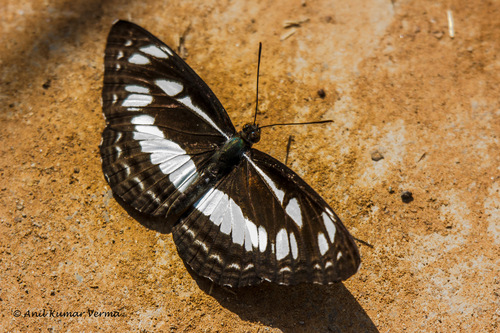
Male Neptis jumbah Moore, 1857 somewhat resembles Neptis columella, but differs in a number of features. On the upperside, the base color is fuliginous black, with interspaces between veins that are deeper black; these darker interspaces are very visible in certain lights, especially between the subbasal and postdiscal markings on the hindwing. All white markings on the upperside are suffused with very pale bluish green. The posterior two spots of the discal series on the forewing are subequal in size. The postdiscal macular band on the hindwing tends toward obsolescence, ranging from a narrow series of white lunules to a somewhat diffuse, narrow, pale transverse band. On the underside, the ground color is paler than it is in N. columella, while the interspaces between the veins are conspicuously much darker. Postdiscal and subterminal markings on both the forewings and hindwings are diffuse and very ill-defined. N. jumbah can also be distinguished by its discal transverse series of comparatively large dark brown spots. In females, the spots on the forewing and the subbasal band on the hindwing are comparatively broader than they are in males. For both sexes, the dry-season form often has conspicuously broader markings than the wet-season form. Antennae, head, thorax, and abdomen match those of N. columella. The wingspan of this species ranges from 62 to 70 mm. Neptis jumbah is distributed across southern India (including the Nilgiris and Western Ghats), northeast India, Myanmar, the Andaman Islands, and Sri Lanka. Specimens from the Andaman Islands have very broad and diffuse lilacine-white terminal markings on the underside.