About Neptis clinia Moore, 1872
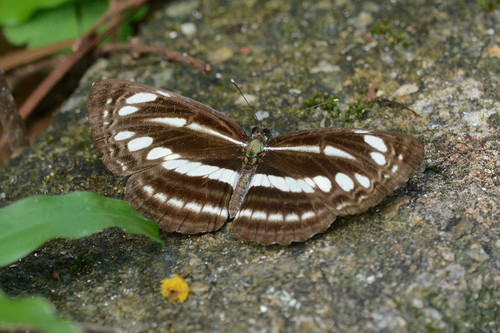
This description covers both male and female Neptis clinia Moore, 1872. On the upperside, the ground color is a rich ferruginous-red, with the basal area slightly tinged with olivescent yellowish-ferruginous. Cilia are alternately black and white. The forewing has three slender black bars crossing the cell, with three similar matching bars below the cell between the basal interspaces of the middle and lower medians. Beyond the cell sits a large, outwardly-oblique pure bluish-white, more or less triangular spot, followed by a transverse discal macular band that is broadest in the dry-season brood. This band is made up of a series of large, broad pure bluish-white spots that run from the costa to the posterior margin. The upper five of these spots are subapical, arranged obliquely outward; the third and fourth are ovate, the upper two are very slender and divided by the second subcostal branch, and the fifth is by far the smallest. The next four spots are arranged somewhat obliquely inward and are much larger: the sixth (upper) spot is triangularly ovate, the seventh is the longest and either bluntly ovate or somewhat quadrate, the eighth is quadrate with an indented outer edge, and the lowest spot is narrow. All of these white spots are bordered with black, and this black color extends broadly from the cell along the costa, then decreases in width toward the hind margin. Beyond this band is an outer marginal broad black waved band, with a lunular inner edge that is occasionally dentate. This black band is crossed by two contiguous slender grey sinuous marginal lines. The hindwing has three slender black bars crossing the cell, and a small spot between the basal interspaces of the veins above the cell. It has a transverse medial discal broad pure bluish-white macular black-bordered band that ends at the submedian; the band's inner edge is somewhat regular, and its outer edge is scalloped. This is followed by an outer discal row of irregular black cordate spots, which are more or less faded toward the posterior and occasionally entirely absent. Next comes a similar submarginal row of smaller dentate spots, and after that a contiguous narrow waved black marginal band crossed by two slender grey sinuous lines. On the underside, the basal area is bluish or olive-grey, while the outer discal area and the apical veins of the forewing are bright red. The discocellular spot on the forewing and the transverse discal macular band, matching their placement on the upperside, are bluish-white or greyish-white and bordered with black. The basal bars are black, and the interspace between the middle cell bars and the bars below the cell on the forewing is bright red. Marginal markings match those on the upperside, except the marginal sinuous lines are violet-grey, and the inner line broadly surrounds the submarginal black spots on the hindwing. The body is red on the upperside; the palpi are black above and greenish-white beneath. The underside of the body and the legs are bluish-grey. Antennae are black, with the tip reddish on the underside. Eyes are bronzy-brown. Images are available via BOLD.