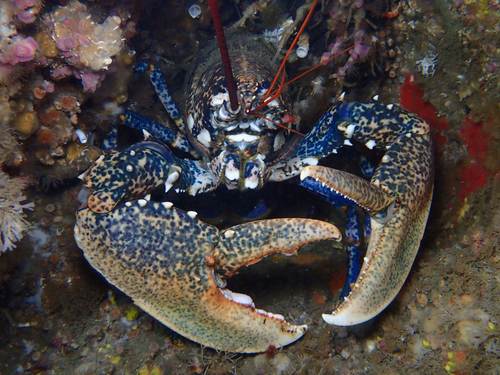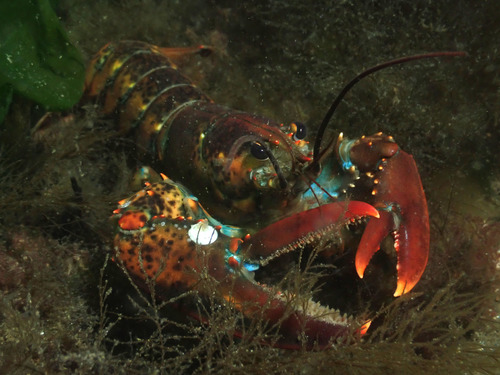
About Nephrops norvegicus (Linnaeus, 1758)
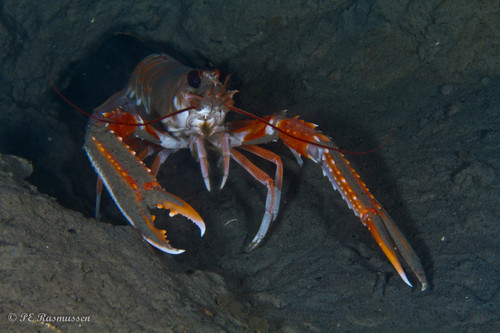
Nephrops norvegicus has a body shape typical of a lobster, though it is narrower than lobsters of the larger-bodied genus Homarus. Its body is pale orange, and it grows to a typical total length of 18–20 centimetres (7–8 inches), including the tail and claws, with an exceptional maximum recorded length of 25 centimetres (10 inches). A carapace covers its cephalothorax, while the abdomen is long and segmented, ending in a broad tail fan. Claws are present on the first three pairs of walking legs; the first pair of these claws is greatly elongated and bears ridges of spines. Nephrops norvegicus has two pairs of antennae, of which the second pair is longer and thinner. It also has a long, spinous rostrum, and its compound eyes are kidney-shaped. This eye shape gives the genus its name, derived from the Greek roots νεφρός (nephros, meaning "kidney") and ὄψ (meaning "eye"). Nephrops norvegicus is distributed in the north-eastern Atlantic Ocean and North Sea, ranging as far north as Iceland and northern Norway, and as far south as Portugal. It can also be found in the Mediterranean Sea, and is common in the Adriatic Sea, particularly the northern Adriatic. It is completely absent from both the Black Sea and the Baltic Sea. Because it has specific ecological requirements for particular sediment types, N. norvegicus has a very patchy distribution, split into more than 30 distinct populations. These populations are separated by terrain unsuitable for the species, and adult individuals rarely travel distances greater than a few hundred metres. Adult Nephrops norvegicus prefer to live on muddy seabed sediments that contain more than 40 percent silt and clay. Their burrows are semi-permanent, and vary in both structure and size. Typical burrows are 20 to 30 centimetres (8 to 12 inches) deep, with 50 to 80 centimetres (20 to 30 inches) of distance between the front and back entrances. Norway lobsters, the common name of Nephrops norvegicus, spend most of their time either resting inside their burrows or near the burrow entrance, and only leave their shelters to forage or mate. The typical lifespan of Nephrops norvegicus is 5–10 years, and can reach 15 years in exceptional cases. Its reproductive cycle changes with geographic location: the timing of hatching and spawning, and the length of the egg incubation period, vary with latitude, and the breeding cycle shifts from annual to biennial when moving from southern to northern regions. Egg incubation is temperature-dependent, and incubation duration increases in colder climates. In colder regions, this means hatching may occur too late for females to participate in that year's breeding cycle. In warmer climates, the combined effects of post-moulting recovery and ovary maturation can delay spawning, which causes females to miss a year of carrying eggs. Adult male N. norvegicus moult once or twice a year, usually in late winter or spring. Adult females moult up to once a year, in late winter or spring, after their eggs have hatched. In regions with annual breeding cycles, mating takes place in winter or spring, when females are in their soft post-moult stage. Ovaries mature over the spring and summer months, and egg-laying occurs in late summer or early autumn. After spawning, egg-carrying (berried) females return to their burrows and remain there until the end of the incubation period. Hatching happens in late winter or early spring. Females moult and mate again soon after hatching. During the planktonic larval stage, which typically lasts 1 to 2 months, Nephrops larvae perform diel vertical migration as they are dispersed by local currents. This complex interaction between biological behaviour and physical oceanography determines larval survival: the destination of the currents that carry larvae must overlap with the spatial distribution of suitable benthic habitats for larvae to successfully settle and reach maturity.