About Nephromopsis merrillii (Du Rietz) Divakar, A.Crespo & Lumbsch
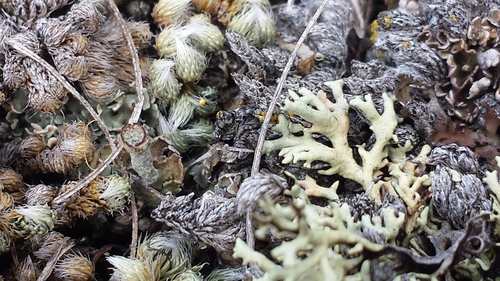
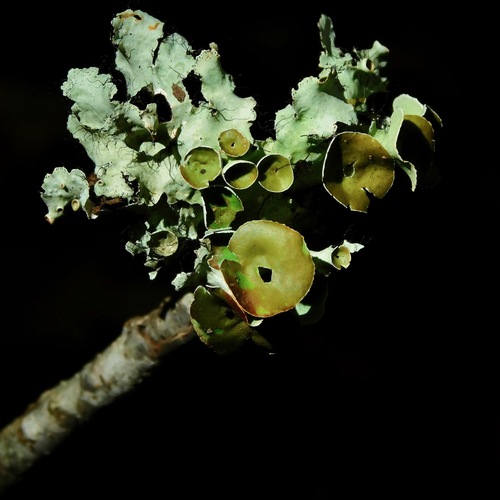
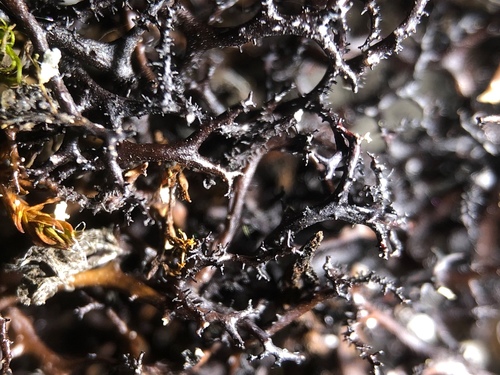
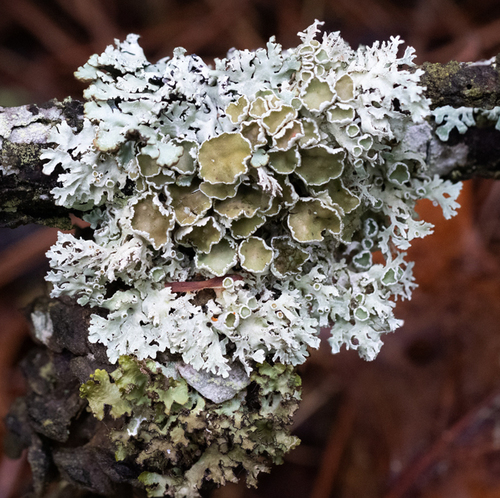
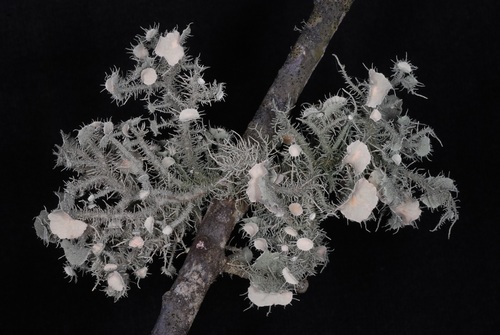
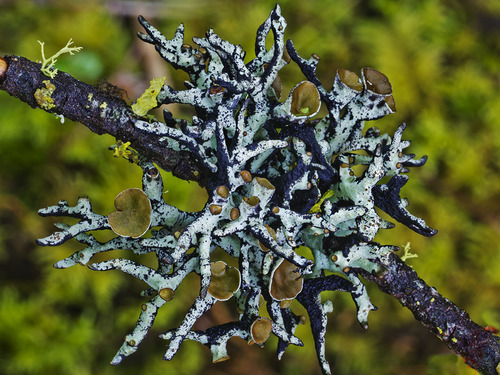
This lichen species, previously called Kaernefeltia merrillii, forms a small dark thallus that is usually less than 2 cm across. Its color ranges from dark greenish-black to dark olive or black. The lobes are somewhat fruticose, meaning they are short, narrow, somewhat bushy, and typically finely divided to under 1 mm wide, though occasional lobes are wider than 1 mm. The surface lacks any vegetative propagules: both soredia and isidia are absent. Sexual reproductive structures called apothecia are common and match the color of the thallus. Standard lichen spot test reactions for this species are all negative. In the field, this lichen can be misidentified as other dark olive-black cetrarioid species, but the combination of a very small thallus, finely dissected narrow lobes, absence of soredia and isidia, and negative spot tests is diagnostic for this species. This lichen’s geographic distribution spans western North America, extending from southeastern Alaska and the Yukon southward through British Columbia to California, and reaching inland as far as western Montana. It is most abundant in the region between the crest of the Cascade Range and the Continental Divide, with particularly robust populations growing in the Siskiyou Mountains of southern Oregon and northern California. It does not grow along the immediate Pacific coastline. It has also been reported from northern Mexico, and has a disjunct population in the central highlands of Spain, where it grows on the twigs of Cistus ladanifer. The lichen colonizes bark and wood substrates, especially the twigs of conifers including whitebark pine (Pinus albicaulis), lodgepole pine (P. contorta), ponderosa pine (P. ponderosa), and western larch (Larix occidentalis). It also grows on shrubs, most commonly manzanita (Arctostaphylos). It prefers well-lit branches in forests and on exposed trees, including Pinus albicaulis growing on rocky ridges, and can also be found high in the canopies of moist, low-elevation forests. Across its entire range, it occurs at all forested elevations, from near sea level up to approximately 2,200 m (7,200 ft). In northern California and southern Oregon, it is a conspicuous component of heavily lichenized shrubs on serpentine barrens and in open Pinus jeffreyi woodlands. East of the Cascades, it is often abundant on fallen pine branches, where it forms dense communities alongside Vulpicida canadensis, Cetraria platyphylla, Letharia vulpina, and Nodobryoria abbreviata. Other commonly recorded associated lichen species include Bryoria fremontii, B. fuscescens, Letharia columbiana, and Tuckermannopsis orbata.