About Nephroma arcticum (L.) Torss.
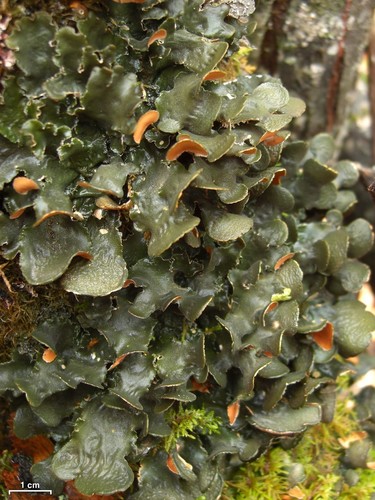
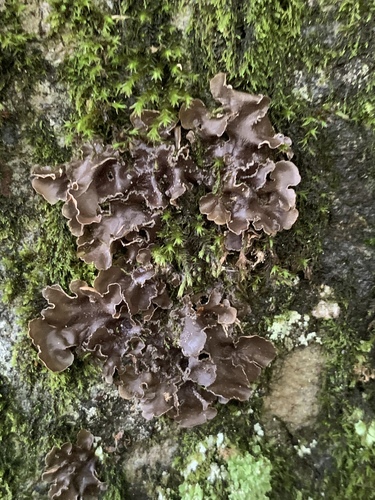
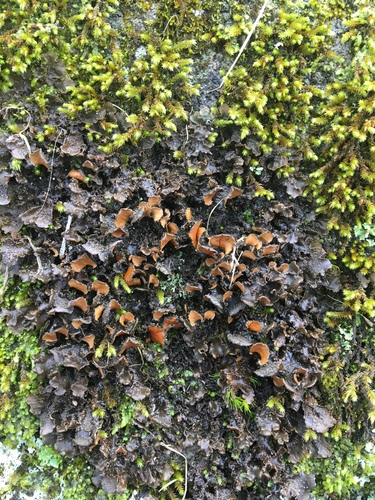
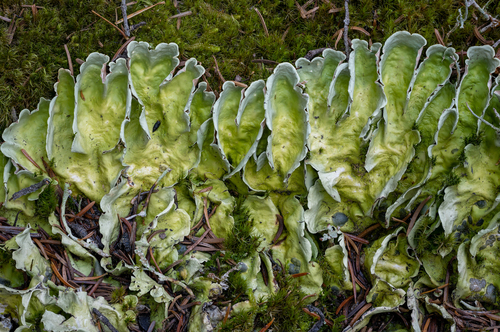
Nephroma arcticum has a foliose thallus that sometimes forms rosettes and sometimes grows irregularly. It reaches up to about 8 cm (3 in) across, and rarely up to 15 cm (6 in) across. Individual thalli can merge to form loose colonies up to 1 m (3.3 ft) wide. Individual thallus lobes are up to 2–5 cm (0.8–2.0 in) wide; they are tongue-shaped, smooth or slightly pitted, and have ascending margins. The upper surface of the thallus is yellow-green, blue-green or bright green, and often glossy. In contrast, the thallus undersurface is dull, with paler margins and darker colour towards the centre, and covered in a thick tomentum. The absence of veins and rhizines distinguishes this species from similar-looking Peltigera species. Apothecia are common in Nephroma arcticum. They are red-orange to red-brown, kidney-shaped, and typically measure 1–2 cm (0.4–0.8 in) in diameter. Spores are 23–30 by 4–5 μm, somewhat fusiform in shape, and contain three internal partitions called septa. Conidiomata are rare; when they do occur, they appear at the margins of the lobes. They produce asexual spores called conidia that measure 3–4 by 1–2 μm. The primary photobiont (photosynthetic partner) is green algae from the genus Coccomyxa; cyanobacteria from the genus Nostoc are held in large, bluish cephalodia that are easily visible in moist thalli. This species does not produce either isidia or soredia, the vegetative propagules found in many lichens. A blue-green phycotype of Nephroma arcticum, meaning it shares the same fungal partner but has a different photosynthetic partner, was first reported from Norway in 1983. The chemistry of this blue-green phycotype is identical to that of the more common green phycotype, except the blue-green phycotype does not contain usnic acid. The cephalodia of N. arcticum can occasionally grow into separate, moderate-sized thalli. These outgrowths are a cyanobacterial form of the species that has been found in moist inland forests of British Columbia at lower elevations. While these forms resemble N. silvae-veteris, they can be distinguished by their chemistry (medulla K negative, PD negative) and their physical connection to typical N. arcticum lobes. In North America, N. arcticum is one of only two members of the genus Nephroma that use green algae as their primary photobiont; the other is N. expallidum, also called alpine kidney lichen. While both species contain cyanobacteria in cephalodia, N. expallidum can be distinguished by its narrower lobes with distinctly crenulate margins, and its cephalodia are not visible on the upper surface. N. expallidum also has a more restricted distribution, confined primarily to arctic tundra and northern boreal woodlands. All other North American Nephroma species form symbioses exclusively with cyanobacteria, which results in darker thalli that appear brown when moistened. The species has a primarily arctic range. It occurs throughout northern Canada from Alaska to Newfoundland, with isolated populations extending into New England and Wyoming. In Canada, it is classified as abundant (S5) in British Columbia, Labrador, Quebec, and Yukon Territory, while it is rare (S1) in Saskatchewan and imperiled (S2) in Nova Scotia and New Brunswick. In coastal Alaska, the species grows on tree trunks, particularly those of Sitka spruce (Picea sitchensis) and Western hemlock (Tsuga heterophylla) in high-elevation forests. In British Columbia, it occurs in the Spruce-Willow-Birch biogeoclimatic zone. In Greenland, N. arcticum grows among mosses on soil in dwarf shrub heath. Nitrogen fixation performed by its cyanobacterial partner enables N. arcticum to outcompete neighbouring plants and colonize moss-covered rocks in nutrient-poor environments. The species reaches its largest sizes and produces abundant reproductive structures in arctic climates. It is classified as a somewhat oceanic lichen, occurring most frequently in oceanic areas and more rarely in continental areas. One study of nearly 300 species of Western Carpathian flora, including vascular plants, bryophytes, and terrestrial lichens, suggests that Nephroma arcticum is one of the few species with a high probability of being a glacial relict. It is rare in the United Kingdom. Nephroma arcticum plays ecological roles in arctic and subarctic environments through its symbiotic relationships, nitrogen fixation in nutrient-poor soils, environmental adaptations, and interactions with diverse organisms. Indigenous Alaskans historically used N. arcticum as both food and medicine, often boiling it and serving it with crushed fish eggs. The Yup'ik people, who have inhabited western Alaska for generations, know this lichen as kus'koak and have traditionally incorporated it into their practices. According to ethnobotanist Wendell Hillman Oswalt, after being cooked in water, the lichen was fed to a person in a weak condition to make him strong.