About Nephrolepis exaltata (L.) Schott
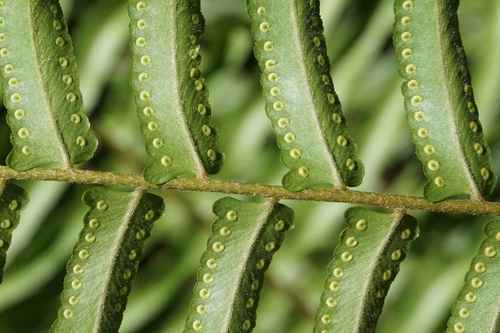
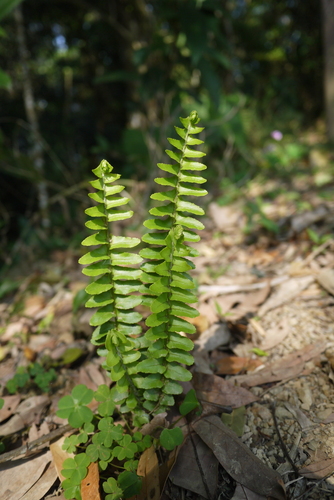
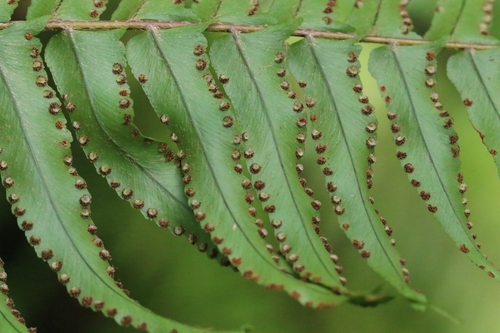
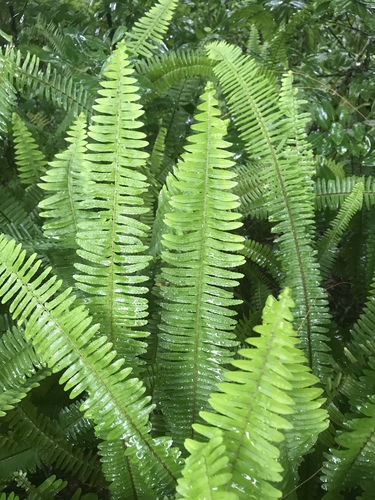
The fronds of Nephrolepis exaltata are 50–250 centimetres (20–98 in) long and 6–15 centimetres (2.4–5.9 in) wide, with alternate pinnae (the small "leaflets" on either side of the midrib). Each individual pinna is 2–8 centimetres (0.79–3.15 in) long. Pinnae are generally deltoid, and a pinnate vein pattern is visible on these highly compound leaves. Pinnae edges are slightly serrate, and the fronds are linear to lanceolate and glandular. The rachis bears monochrome sprout shoots. Leaflets are entire, undivided, and oblong-lanceolate, reaching up to 4.8 inches (120 mm) long and up to 0.9 inches (23 mm) wide. They are spaced less than 1 centimetre (0.39 in) apart. The sori are rounded, and the spores are warty and wrinkled. Nephrolepis exaltata forms a slender, tuberous underground rhizome. The species produces erect fronds, but the cultivars Nephrolepis exaltata 'Bostoniensis' (Boston fern) and 'Teddy Junior' have gracefully arching fronds. This arching frond mutation was discovered in 1894, in a shipment of N. exaltata sent to Boston from Philadelphia. David Fairchild documented an alternative proposed origin for the name Boston fern: that the term came from Florida pioneer nurseryman John Soar, who sent the plants to a friend in Boston.
This fern is common in humid forests and swamps, particularly in northern South America, Mexico, Central America, Florida, the West Indies, Polynesia, and Africa. N. exaltata grows well in moist, shady locations, and is found frequently in swamps and floodplains. It can grow both as a terrestrial plant and as an epiphyte, and grows epiphytically on Sabal palmetto.
Nephrolepis exaltata is a very popular houseplant, often grown in hanging baskets or similar settings. It is a perennial plant hardy in USDA plant hardiness zones 9–11. Although the fern may appear completely dead after periods of frost, it will re-emerge in the spring. In general, Boston fern grows well in damp, well-drained, nutrient-rich soil, and among common cultivated ferns, it is the most tolerant to drought. Boston fern is adapted to humid conditions, so when grown indoors as a houseplant, misting is necessary when relative humidity falls below around 80%. While the plant prefers partial or full shade when grown outdoors, it does not grow in full shade indoors, and responds best to bright filtered light. Named cultivars do not grow true from spores, so the plant is usually propagated by dividing rooted runners. This species is known to be non-toxic, so it is safe around pets.