About Nephelium lappaceum L.
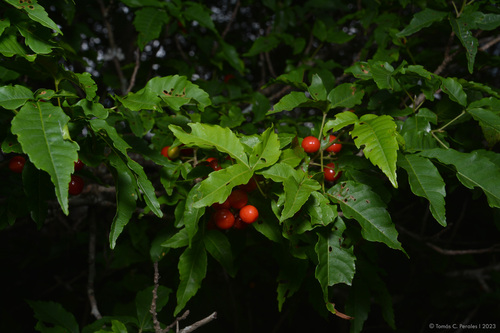
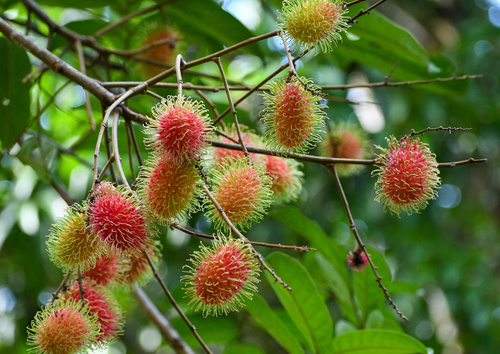
Nephelium lappaceum L., commonly called rambutan, is an evergreen tree that reaches 15–24 m (49–79 ft) in height. Its leaves are alternate, 14–30 cm (6–12 in) long, pinnate, with 3 to 11 leaflets. Each individual leaflet is 5–15 cm (2–6 in) long and 3–10 cm (1.2–3.9 in) broad, with an entire (smooth un-toothed) margin. The tree produces small apetalous, discoidal flowers that measure 2.5–5 mm (0.1–0.2 in) across; these grow in erect terminal panicles 15–30 cm (6–12 in) wide. Rambutan trees fall into three sexual categories: male trees, which only produce staminate flowers and never bear fruit; female trees, which only produce functionally female flowers; and hermaphroditic trees, which produce mostly female flowers with a small percentage of male flowers. The center of genetic diversity for rambutans is the Indonesian region. The species has been widely cultivated across Southeast Asia, including Malaysia, Thailand, Myanmar, Sri Lanka, Indonesia, Singapore, and the Philippines, and has spread from this region to parts of Asia, Africa, Oceania, and Central America. Aromatic rambutan flowers are highly attractive to many insects, especially bees. The main pollinators of rambutan are flies (Diptera), bees (Hymenoptera), and ants of the genus Solenopsis. Within Diptera, flies of the genus Lucilia are the most abundant visitors, while within Hymenoptera, honey bees (Apis dorsata and A. cerana) and stingless bees of the genus Trigona are the major visitors. Colonies of A. cerana foraging on rambutan flowers produce large quantities of honey. Bees foraging for nectar regularly contact the stigma of female flowers and collect significant amounts of sticky pollen from male blossoms. Very little pollen has been observed on bees foraging female flowers. Though male rambutan flowers open at 06:00, foraging activity by A. cerana is most intense between 07:00 and 11:00, and tapers off abruptly after this window. In Thailand, A. cerana is the preferred species for small-scale rambutan pollination; the bee’s body hairs help hook pollen and transport it to female flowers. Rambutans are adapted to warm tropical climates with temperatures between 22–30 °C (72–86 °F), and are sensitive to temperatures below 10 °C (50 °F). Commercial cultivation occurs within 12–15 degrees of the equator. Trees grow well at elevations up to 500 m (1,600 ft) above sea level, and grow best in deep, organic matter-rich clay loam or sandy loam. They thrive on hilly terrain that provides good drainage. Rambutans are propagated via grafting, air-layering, and budding. Budded trees may begin fruiting after two to three years, and reach optimum production after eight to ten years. Trees grown from seed begin bearing fruit after five to six years. In some commercial cultivars, the edible aril is attached to the seed, but freestone cultivars with detached arils are available and in high demand. Rambutan fruit usually contains a single light brown seed, which is high in fats and oils (primarily oleic acid and arachidic acid) that are valuable to industry, and used in cooking and soap manufacturing. Rambutan roots, bark, and leaves have various uses in traditional medicine and in dye production. In some growing regions, rambutan trees can bear fruit twice annually: once in late fall and early winter, with a shorter fruiting season in late spring and early summer. In other areas like Costa Rica, there is a single annual fruit season: the start of the rainy season in April stimulates flowering, and fruit typically ripen in August and September. Rambutan fruit is fragile and must ripen on the tree, then is harvested over a four- to seven-week period. Fresh rambutan fruit bruises easily and has a limited shelf life. An average mature tree may produce 5,000–6,000 or more fruit, equal to 60–70 kg (130–155 lb) per tree. Yields start at 1.2 tonnes per hectare (0.54 short tons per acre) in young orchards, and can reach 20 tonnes per hectare (8.9 short tons per acre) on mature trees. In 1997 in Hawaii, 24 of the 38 total cultivated hectares of rambutan were harvested, producing 120 tonnes (130 short tons) of fruit. Yields can be increased through improved orchard management (including better pollination practices) and by planting high-yielding compact cultivars. Most commercial rambutan cultivars are hermaphroditic. Cultivars that produce only functionally female flowers require the presence of male trees to produce fruit. Male trees are seldom grown, because vegetative selection has favored hermaphroditic clones that produce a high proportion of functionally female flowers and a much lower number of pollen-producing flowers. Male panicles hold over 3,000 greenish-white flowers; each male flower has five to seven anthers, five to seven stamens, yellow nectaries, and a nonfunctional ovary. Each hermaphroditic panicle holds around 500 greenish-yellow flowers. Each hermaphroditic flower has six anthers, one ovule in each of its two locules, and usually a bilobed stigma. Flowers are receptive for about one day, but may persist if pollinators do not visit them. In Thailand, rambutan trees were first planted in Surat Thani in 1926 by Chinese Malay K. Vong in Ban Na San; an annual rambutan fair is held each August during harvest. In Malaysia, rambutan flowers from March to July, and again between June and November, usually in response to rain following a dry period. Flowering periods differ in other locations. Most (but not all) rambutan flowers open early in the day. During peak bloom, up to 100 flowers in each female panicle may open per day. Initial fruit set can approach 25 percent, but high fruit abortion leads to a much lower final production at harvest, between 1 and 3 percent. Fruit matures 15 to 18 weeks after flowering. Rambutan cultivation in Sri Lanka mainly consists of small home gardens. Malwana, a village in the Kelani River Valley, is known for its rambutan orchards; its rambutan production reaches markets in May, June, and July, when seasonal traders commonly sell along the streets of Colombo. Sri Lanka also produces off-season rambutan in January and February in areas including Bibile, Medagama, and Monaragala. Both male and female rambutan flowers are faintly sweet-scented, and have functional nectaries at the base of the ovary. Female flowers produce two to three times more nectar than male flowers. Nectar sugar concentration ranges between 18–47 percent, and is similar for both flower types. Rambutans are an important nectar source for bees in Malaysia. Cross-pollination is required because most functionally female flowers lack anthers. While apomixis may occur in some cultivars, rambutans, like lychee, depend on insects for pollination. In Malaysia, where only about one percent of female flowers set fruit, bagged (pollinator-excluded) flowers set no fruit, while hand pollination resulted in a 13 percent fruit set. Pollinators may stay faithful to either male or hermaphroditic flowers (and thus trees), which limits pollination and fruit set under natural conditions where crossing between male and female flowers is required.