About Nepenthes tentaculata Hook.fil.
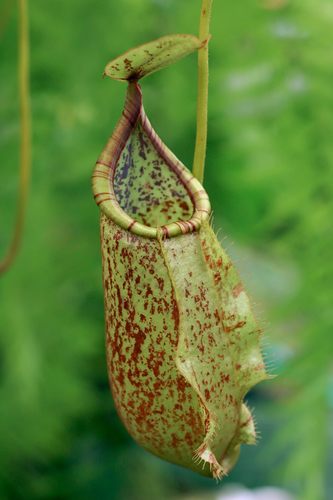
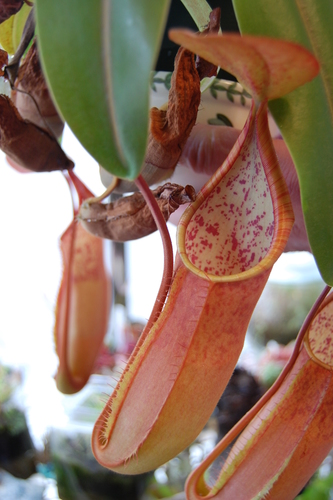
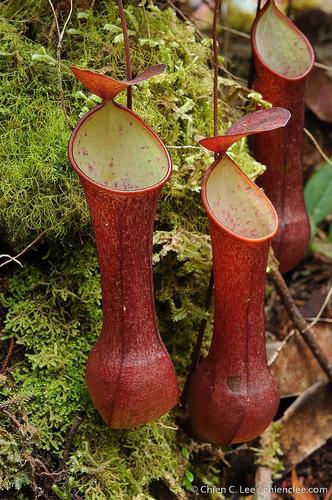
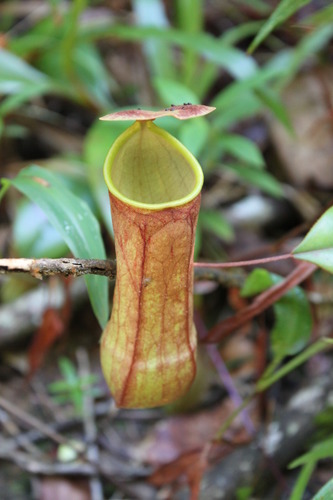
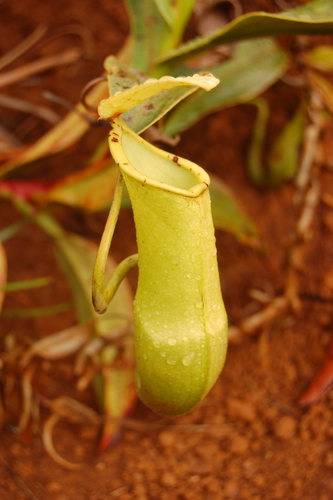
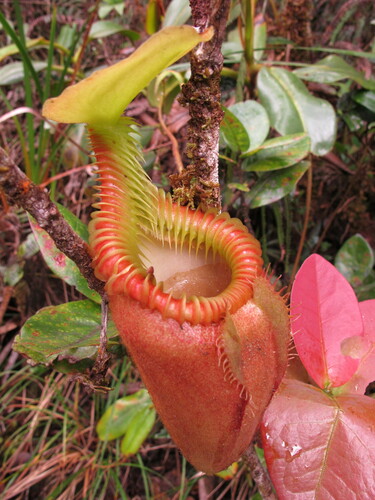
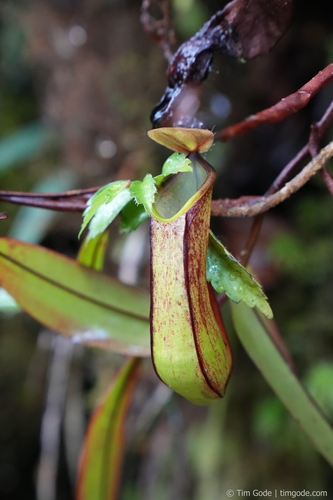
Nepenthes tentaculata Hook.fil. is a climbing plant. Its stem can reach 3 m in length and up to 5 mm in diameter. Internodes are circular to triangular in cross section and grow up to 10 cm long. This species has sessile leaves. The leaf blade (lamina) is lanceolate to elliptic, measuring up to 15 cm long and 3 cm wide. The leaf apex is rounded to acute, while the leaf base is amplexicaul, cordate, and encircles the stem. Up to 4 longitudinal veins occur on either side of the midrib, and pinnate veins are irregularly reticulate. Tendrils grow up to 15 cm long. The pitchers of N. tentaculata are generally quite small, rarely exceeding 15 cm in height; exceptional specimens may reach up to 30 cm high by 8 cm wide. Rosette and lower pitchers are ovoid in the basal third and cylindrical above, while upper pitchers are more cylindrical along their entire length. A pair of fringed wings runs down the front of lower pitchers, but these wings are often reduced to ribs in upper pitchers. The pitcher mouth is usually ovate, becoming acute at the front and rear, and has a very oblique insertion. The peristome is roughly cylindrical in cross section, up to 5 mm wide, bears small ribs, and has tiny teeth lining its inner margin. The inner portion of the peristome makes up approximately 57% of its total cross-sectional surface length. The pitcher lid (operculum) is ovate and typically obtuse. Numerous filiform appendages are often present on the upper surface of the lid, concentrated near the edge, but some forms of the species lack these structures entirely. N. tentaculata has a racemose inflorescence. The peduncle grows up to 15 cm long and the rachis up to 10 cm long, with female inflorescences generally shorter than male ones. Pedicels are bract-less and reach 10 mm in length. Sepals are oblong-lanceolate and up to 3 mm long. A study of 210 pollen samples from a Bornean herbarium specimen (Mjöberg 49, collected at 1,700 m altitude) found a mean pollen diameter of 29.8 μm (standard error = 0.4; coefficient of variation = 9.4%). All parts of N. tentaculata are glabrous, with no indumentum (hairs) present. In terms of ecology, N. tentaculata has a wide distribution across Borneo and Sulawesi. It is particularly widespread in Borneo, where it has been recorded from almost every mountain over 1,000 m in elevation. It usually grows at altitudes between 1,200 and 2,550 m above sea level, but has been found as low as 740 m, and sometimes even 400 m, on coastal mountains such as Mount Silam in Sabah and Mount Santubong in Sarawak. The species typically inhabits mossy forest, though it has also been recorded from ridge-top vegetation on mountain summits. Unlike many other Nepenthes species, N. tentaculata does not grow as an epiphyte; it always grows terrestrially. Plants often grow in clumps of Sphagnum moss, spreading vegetatively via creeping subterranean stems. The conservation status of N. tentaculata is listed as Least Concern on the IUCN Red List, based on a 2018 assessment. This matches an informal 1997 assessment by Charles Clarke, who also classified the species as Least Concern under IUCN criteria. In 1995, the World Conservation Monitoring Centre classified N. tentaculata as "not threatened".