About Nepenthes rafflesiana Jack
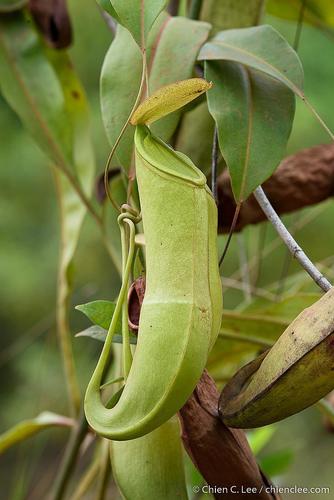
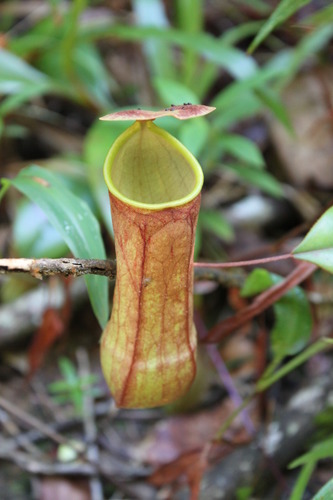
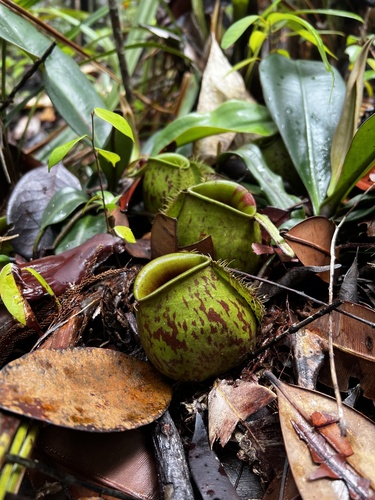
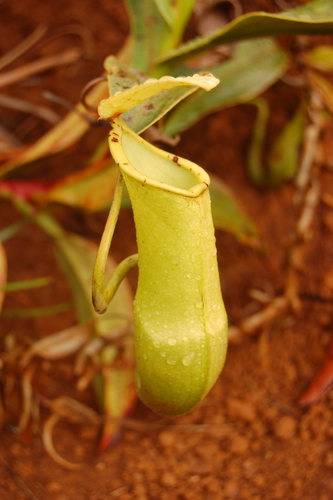
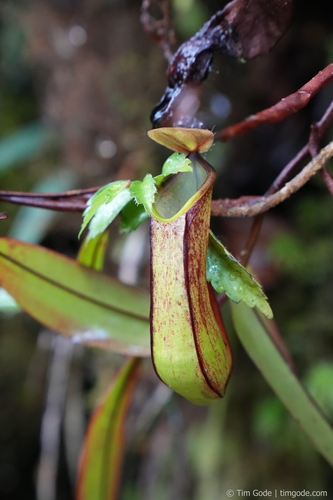
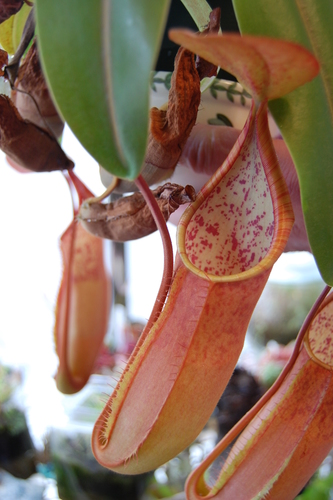
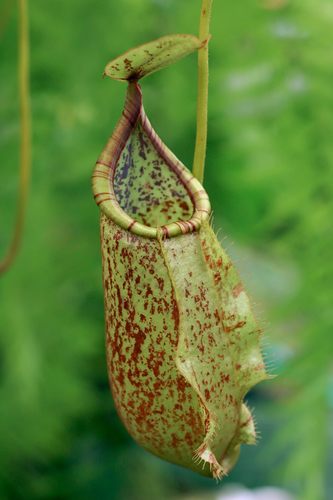
Nepenthes rafflesiana Jack is a scrambling vine. Its stem can climb up to 15 m (49 ft) in height and reaches up to 10 mm (0.4 in) thick, with internodes up to 20 cm (7.9 in) long. Tendrils may grow over 110 cm (43 in) long. The lower, terrestrial pitchers of this species are bulbous and have well-developed fringed wings. These traps rarely exceed 20 cm (7.9 in) in height, but the giant form of N. rafflesiana is known to produce pitchers up to 35 cm (14 in) long and 15 cm (5.9 in) wide. Upper pitchers are funnel-shaped and often have a distinctive raised section at the front of the peristome. Both types of pitchers have a characteristically elongated peristome neck that can be 3 cm (1.2 in) or more in length. Pitcher colouration varies widely, ranging from dark purple to almost completely white. The typical form of N. rafflesiana is light green overall, with heavy purple blotches on lower pitchers and cream-coloured aerial upper pitchers. The inflorescence is a raceme that grows between 16 and 70 cm (6.3 and 27.6 in) tall. Red or purple flowers usually grow singly, or sometimes in pairs, on each flower stalk. Young plants are entirely covered with long, caducous, brown or white hairs. Mature plants often have a sparse indumentum of short, brown hairs, though they may be completely glabrous. Nepenthes rafflesiana is a widespread lowland species. It is common in Borneo and parts of the Riau Archipelago, but has a restricted distribution in both Peninsular Malaysia and Sumatra. It has only been recorded from the west coast of Sumatra, between Indrapura and Barus. It is also found in Singapore and on a number of smaller islands, including Bangka, Labuan, Natuna, and the Lingga Islands. N. rafflesiana generally grows in open, sandy, wet areas. It has been recorded in kerangas forest, secondary formations, peat swamp forest margins, heath forest, and seaside cliffs. It grows at elevations ranging from sea level to 1,200 m (3,900 ft), or even 1,500 m (4,900 ft). Nepenthes rafflesiana is very popular in cultivation. It is classified as a lowland Nepenthes, which prefers the hot, humid conditions typical of tropical lowland jungles most of the time, but can also be grown as an intermediate species with cooler nights and lower humidity. It is a comparatively hardy Nepenthes, and is commonly recommended as a "first plant" for new Nepenthes growers. This plant should be grown in shaded conditions, under diffuse sunlight, or in a large grow chamber under artificial lights. Watering and misting should be done frequently, preferably with distilled water, to avoid mineral build-up that is unsightly and may damage the delicate roots of Nepenthes and most other carnivorous plants. Standing water is not recommended. A wet, well-draining potting medium is required for successful growth. Growers use a variety of feeding methods: some feed freeze-dried bloodworms or Koi pellets, both sold in the fish section of most pet stores, while others prefer orchid mixes. No carnivorous plant should ever be fed mammalian meat. This will cause an unpleasant smell, likely lead to rotting of the pitcher, and may potentially kill the plant. The plant's digestive enzymes have not evolved to process large prey items, and rotting material allows opportunistic bacteria and fungi to establish growth.