About Nepenthes bicalcarata Hook.fil.
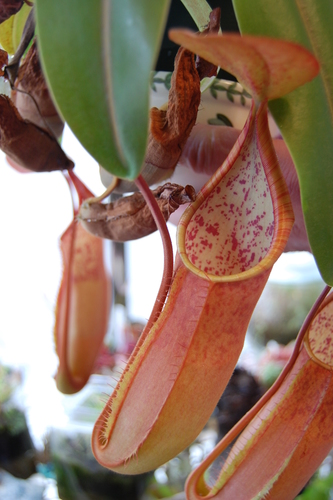
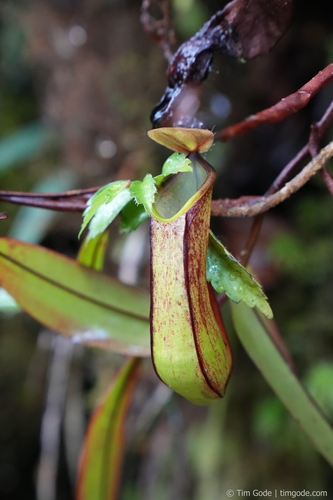
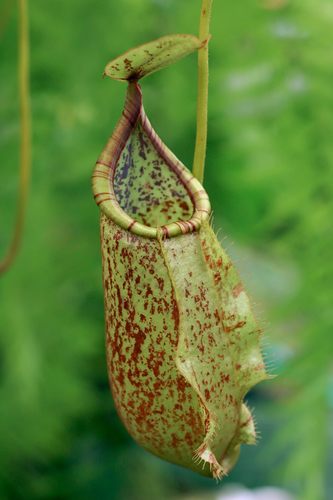
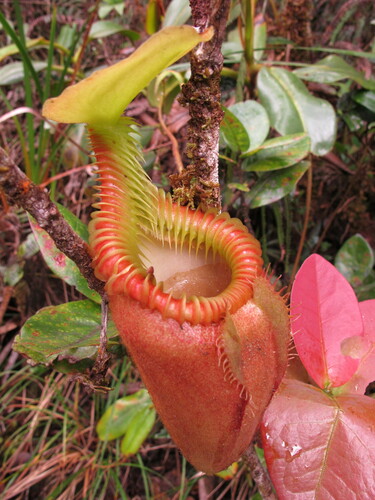
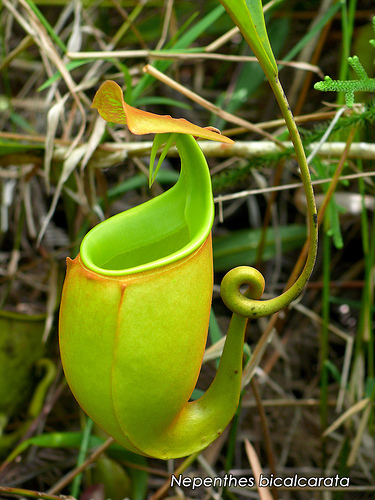
Nepenthes bicalcarata Hook.fil. is the largest species in the Nepenthes genus, with climbing stems that can reach up to 20 m into forest canopies. Its cylindrical stem grows thicker than that of any other Nepenthes species, reaching up to 3.5 cm in diameter, with internodes up to 40 cm long. The leaves of N. bicalcarata are petiolate and coriaceous, with an obovate-lanceolate lamina that also grows to very large dimensions of up to 80 cm long and 12 cm wide. The lamina runs slightly down the stem, forming two narrow wings, and has indistinct longitudinal veins alongside numerous pennate veins. The plant's tendrils can grow up to 60 cm long and 8 mm wide; they are hollow and swollen near the pitcher, and act as the primary residence for ants. The ants obtain most of their food from the plant's many large extrafloral nectaries. Though most parts of N. bicalcarata are exceptionally large, its pitchers are not as large as those of species such as N. rajah, but they still can reach over 1 litre in volume, growing up to 25 cm high and 16 cm wide. Lower pitchers have a pair of prominent fringed wings, up to 15 mm wide, that run down the front of the pitcher; these are usually reduced to ribs in aerial pitchers. The peristome, which measures up to 20 mm wide, has a characteristic flattened shape that curves inwards. Around 70% of the peristome's total cross-sectional surface length comes from its inner portion, and it bears small but distinct teeth. The two sharp spines that the species is famous for grow on the underside of the pitcher lid, and can reach up to 3 cm long. These spines are derived from the uppermost 10–12 peristome ribs. The pitcher lid (operculum) is shaped from reniform to cordate, and has no appendages. An unbranched spur, up to 15 mm long, is inserted at the base of the lid. N. bicalcarata produces a paniculate inflorescence. The peduncle can grow up to 40 cm long, and the rachis can reach 100 cm in length; female inflorescences are usually shorter. Branches of the flower stem are up to 40 mm long and each bears up to 15 flowers. Sepals are either obovate or lanceolate, and grow up to 4 mm long. Analysis of 120 pollen samples taken from a herbarium specimen (Fosberg 43860, with no altitude recorded) found a mean pollen diameter of 28.9 μm (standard error = 0.4; coefficient of variation = 7.5%). Mature N. bicalcarata plants are almost completely glabrous. Caducous hairs are only present on the youngest parts of the plant and on inflorescences. This species varies very little across its entire range, so no infraspecific taxa have been described for it. In terms of ecology and conservation, N. bicalcarata is endemic to Borneo. It is most common in the peat swamp forests along the island's western coast, which span Sarawak, Sabah, Kalimantan, and Brunei. In these areas, it often grows in the shade of the widespread dipterocarp Shorea albida. The species also grows in kerangas forest, and has even been recorded growing in white sand heath forests in Sarawak and East Kalimantan. In these habitats, it is often sympatric with N. ampullaria. Specimens growing in undisturbed peat swamp forest, where sunlight is highly diffused and humidity is consistently high, grow to the largest dimensions. N. bicalcarata has a shallow root system that only penetrates the top layer of peat and leaf litter, to a depth of around 25 cm. Below this layer, high concentrations of tannins and alkaloids make the substrate toxic. It is generally found at altitudes below 300 m, though Johannes Gottfried Hallier reported a single collection made in 1894 from an elevation between 700 and 950 m above sea level. The conservation status of N. bicalcarata is listed as Vulnerable on the 2006 IUCN Red List of Threatened Species, based on an assessment conducted in 2000. In 1997, Charles Clarke informally classified the species as Near Threatened following IUCN criteria, which matches the conservation status assigned to N. bicalcarata by the World Conservation Monitoring Centre. For cultivation and cultivars, N. bicalcarata can be grown in a similar way to other members of its genus, though it requires relatively hot and humid conditions. It needs large pots to thrive, and temporary stops in growth are often caused by becoming root-bound; repotting into a larger container usually leads to rapid increases in size. When growing conditions are suitable, this plant grows quite quickly for a Nepenthes, reaching a large size relatively rapidly. Despite its natural occurrence in peat swamp forests, N. bicalcarata has been successfully grown in a completely inorganic mix made of one part each of Seramis clay perls, lava gravel, and Lecaton expanded clay perls. N. bicalcarata has been artificially crossed with N. hirsuta; a particularly robust-pitchered cultivar of this hybrid was named Nepenthes 'Hortulanus Otten', in honour of Karel Otten, former curator of the Botanic Garden in Ghent, Belgium. A cultivar of the artificial cross N. bicalcarata × N. × dyeriana was registered in 1988 under the name Nepenthes 'Nina Dodd', named after a relative of Cliff Dodd, who created the hybrid. Two more cultivars of artificial hybrids involving N. bicalcarata have been named: Nepenthes 'Bella', which is ((N. ampullaria × N. bicalcarata) × N. truncata), and Nepenthes 'Rapa', which is N. ampullaria × N. bicalcarata. However, neither of these two names are established, because they were published without accompanying descriptions.