About Nepenthes ampullaria Jack
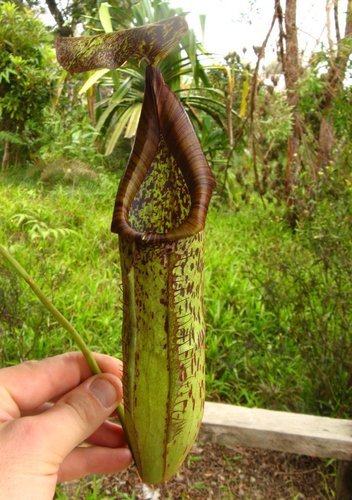
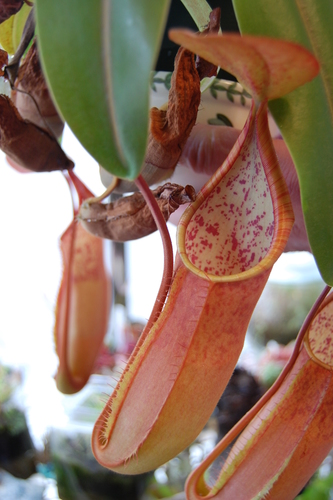
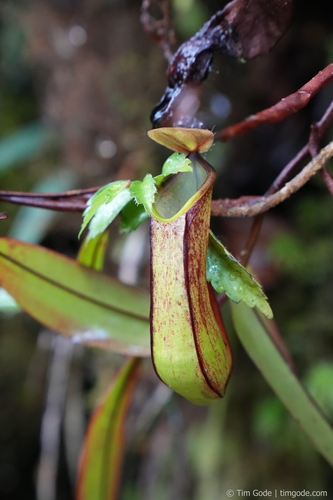
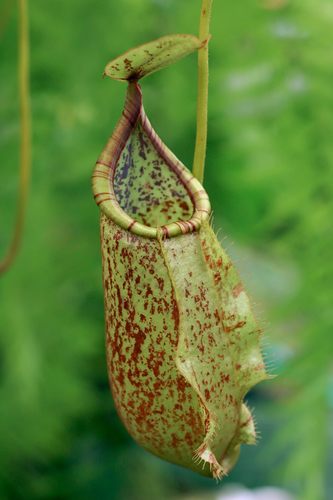
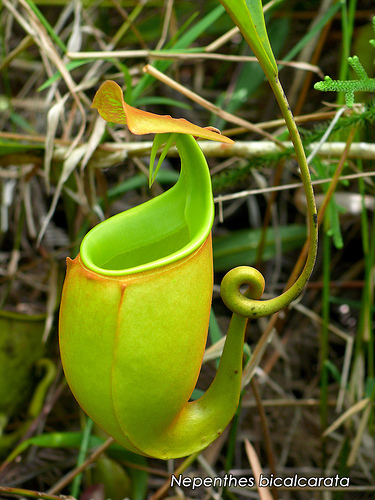
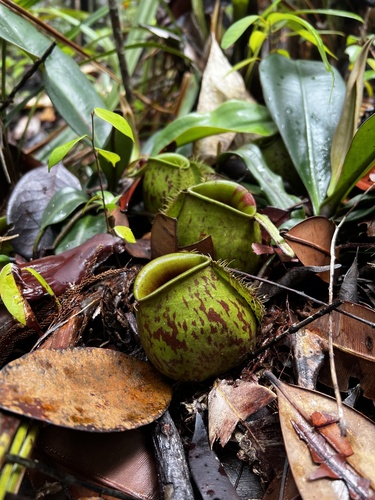
Nepenthes ampullaria Jack is a species of pitcher plant that is difficult to confuse with any other species in the Nepenthes genus, due to its unique pitcher shape and unusual growth habit. Francis Ernest Lloyd translated Hermann Troll's 1932 account of encountering this species as follows: "I came across N. ampullaria among the massive vegetations of a swamp-forest on the island of Siberut off the west coast of Sumatra. It was a fabulous, unforgettable sight. Everywhere, through the network of lianas the peculiarly-formed pitchers of this species gleamed forth, often in tight clusters and, most remarkably, the muddy moss-overgrown soil was spotted with the pitchers of this plant, so that one got the impression of a carpet." This carpet-like appearance comes from the many pink or white foliage leaves that grow directly from the plant's rhizome. The stem of N. ampullaria is light brown and may climb to 15 metres (49 ft) in height. Its leaves are light green, growing up to 25 centimetres (9.8 in) long and 6 centimetres (2.4 in) wide. Pitchers form at the ends of short tendrils that are no longer than 15 centimetres (5.9 in). The pitchers are urceolate (urn-shaped) and generally quite small, rarely exceeding 10 centimetres (3.9 in) in height and 7 centimetres (2.8 in) in width. The peristome (the thickened rim of the pitcher) is strongly curved inward, with the inner section making up around 85% of its total cross-sectional surface length. Upper pitchers are produced very rarely, and are noticeably smaller than the pitchers that grow on rosettes or offshoots. Pitcher colour ranges from all light green to fully dark red, with many intermediate forms documented. In Sumatra and Peninsular Malaysia, N. ampullaria pitchers are almost always solid green or green with red speckles; solid red forms are mostly found only in Borneo. A variant with larger pitchers has been recorded from New Guinea. The inflorescence of N. ampullaria is a dense panicle. It is the only Nepenthes species recorded from Sumatra or Peninsular Malaysia that produces paniculate inflorescences. All parts of young N. ampullaria plants are densely covered with short brown hairs. Mature plants have a sparser covering of hairs, with the exception of their inflorescences. N. ampullaria is one of the most widespread Nepenthes species. It is native to Borneo, the Maluku Islands, New Guinea, Peninsular Malaysia, Singapore, Sumatra, and Thailand. It has also been recorded from many smaller islands, including Bangka, Bengkalis, Ko Lanta, Ko Tarutao, Langkawi, Mendol, the Mentawai Islands (including Siberut), the Meranti Islands (Padang, Rangsang, Tebing Tinggi), Nias, Penang, the Riau Islands (Lingga Islands, Natuna Islands, Riau Archipelago), and Rupat. N. ampullaria most commonly grows in damp, shady forest from sea level up to 2,100 metres (6,900 ft) altitude. In Borneo, it usually grows on relatively flat terrain in kerangas forest, peat swamp forest, and degraded swamp forest, at elevations from 0 to 1,000 metres (3,300 ft). In Sumatra and Peninsular Malaysia, it grows from sea level to 1,100 metres (3,600 ft) altitude on flat terrain in heath forest, padang, belukar, peat swamp forest, degraded swamp forest, and in paddy fields. In New Guinea, it grows predominantly in Araucaria forests. The species has also been recorded growing in secondary forests, open microphyllous vegetation, and swamp grassland. Ecologically, N. ampullaria has largely moved away from carnivory and gets a substantial portion of its nutrients from digesting leaf matter that falls onto the forest floor, meaning it is partially detritivorous. It has evolved several unique traits as an adaptation to catching leaf litter. It is one of only a few species in the genus that lacks "lunate" cells in its pitchers; these are modified stomatal guard cells thought to prevent prey from getting a foothold inside the pitcher. The pitcher lid is unusual: it is very small and reflexed (tilted outwards, rather than covering the pitcher's mouth), which lets leaf litter fall directly into the pitcher. Nectar glands, which are important for prey capture in other carnivorous Nepenthes, are very rare on the pitcher lid of N. ampullaria, and are sometimes completely absent. The marginal glands of the peristome are much smaller than those found in other Nepenthes species. In terrestrial N. ampullaria pitchers, the glandular region extends almost all the way to the peristome, meaning there is little to no conductive waxy zone — the waxy zone in other pitcher plants causes prey to slip and fall into the digestive fluid. The plant's growth structure, which includes subsurface runners and offshoots, is unusual for the genus, and the species often forms a "carpet" of pitchers that covers the soil. This structure maximizes the area over which falling debris can be intercepted. The pitchers of N. ampullaria are relatively long-lived, because the species relies on slow accumulation of nutrients over time. It is thought that infaunal organisms such as mosquito larvae help break down leaf litter and aid the transfer of nitrogen from the litter to the plant, by excreting ammonium ions. Bacterial breakdown of leaf matter is also known to produce ammonium ions. Studies have shown that foliar stable nitrogen isotope (¹⁵N) abundance in N. ampullaria plants growing under forest canopy (where leaf litter fall is present) is significantly lower than in plants that do not have access to litterfall. Conversely, total nitrogen concentrations are higher in plants growing under forest canopy than in those growing in open sites with no litterfall. A 2003 study estimated that N. ampullaria plants growing under forest canopy get 35.7% (±0.1%) of their foliar nitrogen from leaf litter. A 2011 study found that N. ampullaria gets 41.7% (±5.5%) of its laminar nitrogen and 54.8% (±7.0%) of its pitcher nitrogen from leaf litter, and demonstrated that detritivory increases the net photosynthesis rate in the leaf laminae.