About Neotrypaea californiensis (Dana, 1854)
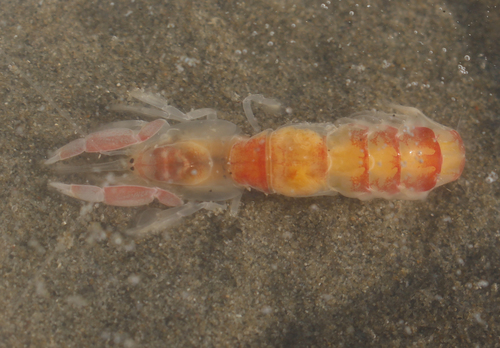
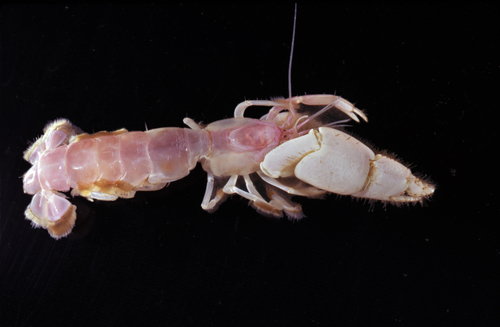
Neotrypaea californiensis grows to a length of 11.5 centimeters (4.5 inches). Its body is creamy white, with pale pink, yellow, or orange patches on its appendages, and a pink abdomen. Adult individuals have one claw that is larger than the other. In males, this larger "master claw" can account for up to 25% of the animal's total body mass, while in females it makes up only around 10% of body mass. The smaller minor claw makes up approximately 3% of total body mass for both sexes. The enlarged claw is equally likely to occur on either the right or left side of the animal. Researchers hypothesize the male's larger claw is used in aggressive encounters or during mating, and its development is likely a product of sexual selection. Females lay eggs in spring or early summer; larvae hatch in summer and live as plankton. Post-larval individuals settle back onto the sea floor in late summer and fall. Both Neotrypaea californiensis and the mud shrimp Upogebia pugettensis inhabit mudflats and sandy substrates in the intertidal zone of estuaries across western North America. Neotrypaea californiensis is distributed from Mutiny Bay, Alaska, south to Punta Abreojos, Mulegé, Baja California Sur, Mexico. The intertidal estuary habitat it occupies is also used for aquaculture of the Pacific oyster, Crassostrea gigas. Because bioturbation activity by Neotrypaea californiensis and Upogebia pugettensis lowers the productivity of oyster beds, the two species are considered pests. However, their activity may create cascading effects across the entire ecosystem, potentially buffering the ecosystem from risks of nutrient enrichment and increasing primary and secondary productivity by raising levels of dissolved inorganic nitrogen. The burrows dug by Neotrypaea californiensis have many branches, and a variety of other animals live within these burrows, including snapping shrimp of the genus Betaeus, the copepod Clausidium vancouverense, and the crab Scleroplax granulata. The gut flora of Neotrypaea californiensis includes a wide diversity of bacteria: approximately 40% are Alphaproteobacteria, 20% are gram-positive bacteria, 20% are Bacteroidota, and Gammaproteobacteria and Campylobacterota each make up 5%. Common predators of Neotrypaea californiensis include gray whales (Eschrichtius robustus), bottom-dwelling fish, and Dungeness crabs (Metacarcinus magister). Because Neotrypaea californiensis harms oyster production, the insecticide carbaryl (1-napthyl N-methyl carbamate) is sprayed in some areas, including Willapa Bay, Washington, to reduce its population. Adding shelly debris also lowers Neotrypaea californiensis numbers: it prevents larval settlement, and young Dungeness crabs that inhabit the shelly debris prey on young Neotrypaea californiensis. Neotrypaea californiensis is used as fishing bait, and is often transported alive between U.S. states. This practice has raised concerns that the species' existing natural population structure may be erased, and that the castrating parasitic isopod Ione cornuta could be introduced to areas outside its native range.