About Neotrygon orientale Last, White & Serét, 2016
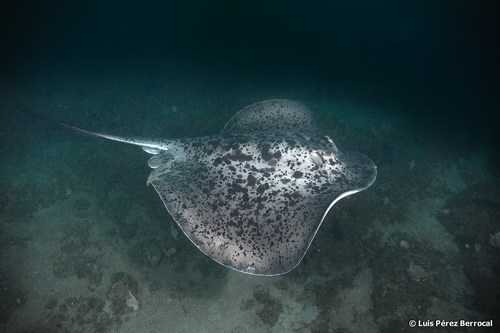
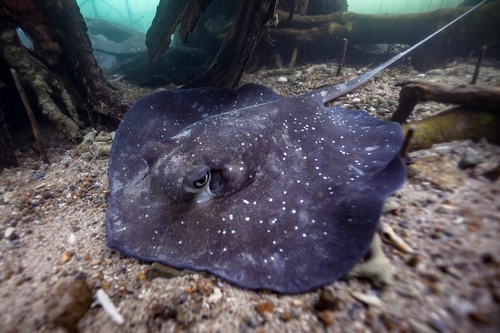
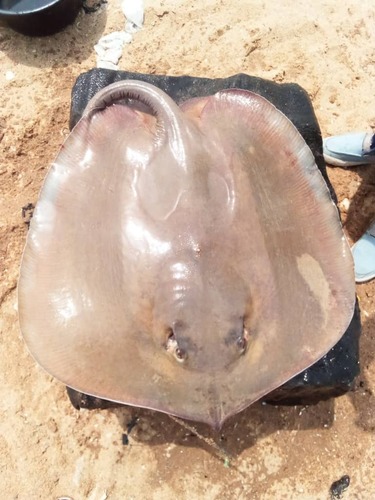
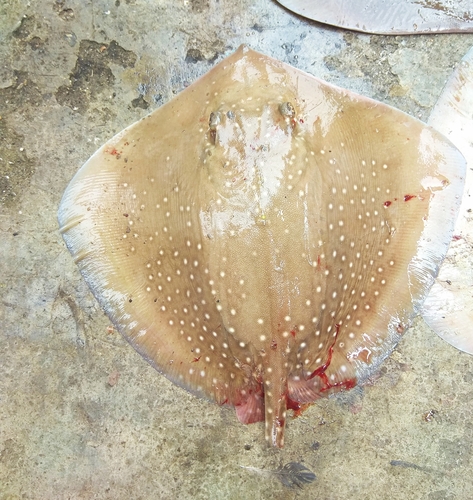
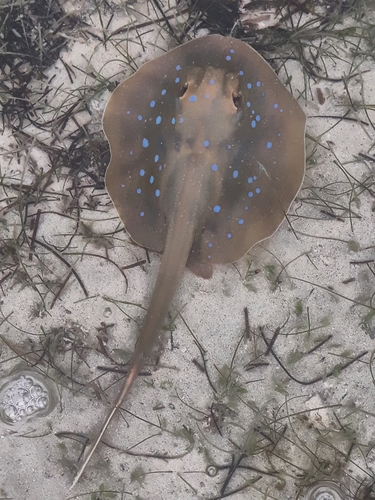
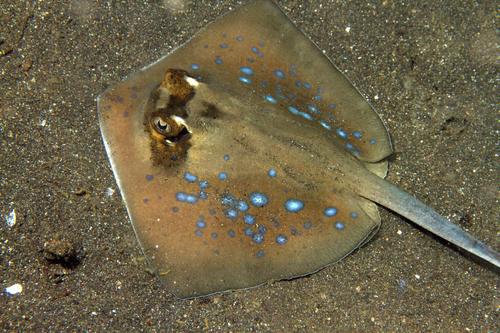
This stingray species, formally named Neotrygon orientale Last, White & Serét, 2016, can be distinguished from its closest relative Neotrygon kuhlii by several consistent traits: abruptly angular pectoral fin tips, a dusky ventral tail fold with a darker edge, a small mouth, prominent mask-like markings, and a body covered in moderate-sized blue spots plus dark peppery spots. The maximum recorded disc width for male specimens is 38 cm. This species is often confused with the recently described Neotrygon yakkoei and all species in the Neotrygon kuhlii complex; high morphological similarity between species in this complex makes reliable identification difficult. Phylogenetically, N. orientale and N. varidens form a sister clade to N. indica, and the three likely share a common ancestor from the Plio-Pleistocene. Snout angle, a trait historically used to separate N. orientale from N. kuhlii, is no longer used for identification because measurements of this trait are highly subjective. However, researchers have been able to accurately identify the Oriental Bluespotted Maskray using spot patterns, tail characteristics, and sex via baited remote underwater video systems (BRUVS) at three separate sites in Malaysian waters. BRUVS also produces more accurate population estimates for this species than older methods. N. orientale has also been confused with the recently described N. indica. It has now been assigned a unique BIN number, a DNA barcode that enables identification when other methods fail. The confirmed distribution of N. orientale includes Sumatra, Java, Kalimantan, and Sulawesi in Indonesia; Sabah and Sarawak in Malaysia; Singapore; Brunei; the Philippines; and Taiwan, spanning the Western Central and Northwest Pacific. It lives in inshore habitats, found from the sea surface down to around 100 meters depth. Within parts of its range, specifically among the Bajau and Laut communities across Indonesia, Malaysia, and the Philippines, this species is regularly caught and kept as a delicacy. Its true full distribution remains unclear due to its strong morphological similarity to other species in the kuhlii complex. This species has viviparous reproduction, and individuals measure approximately 12 cm disc width at birth. The true maximum age of this species is unknown, but based on data from the closely related Coral Sea Maskray (Neotrygon trinoides), its maximum lifespan is estimated to be around 12 years.