About Neotrygon kuhlii (Müller & Henle, 1841)
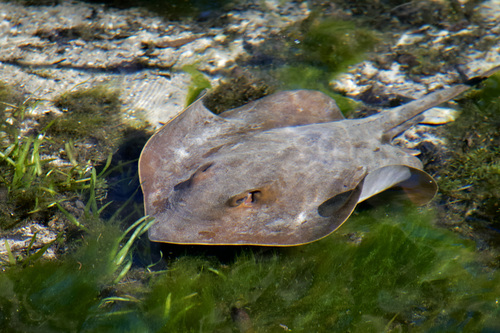
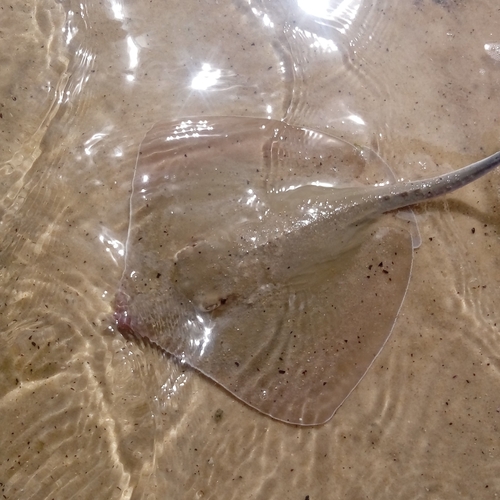
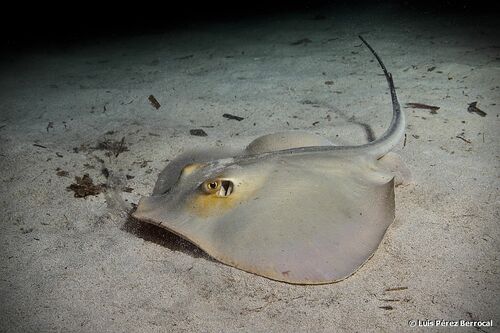
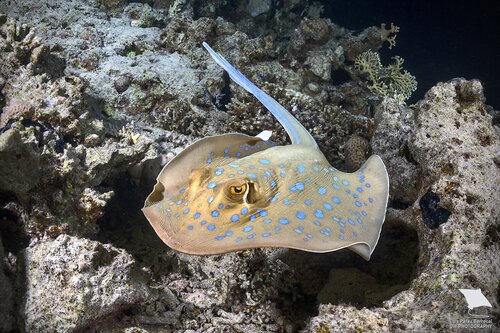
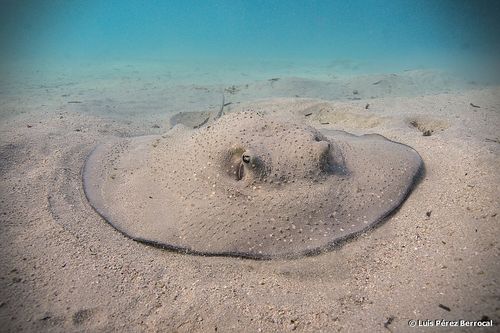
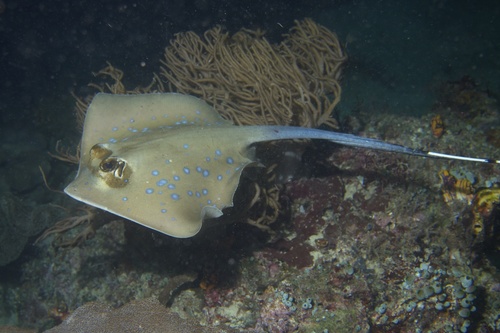
Description and behavior Kuhl's maskray (Neotrygon kuhlii) has a flat, disc-shaped, rhomboid body that reaches up to 47 cm (19 in) in disc diameter and 70 cm (28 in) in total length. Its upper body is dark green with blue spots, and it has a light white underbelly, a color pattern called countershading. Its snout is very short and broadly angular, matching the angular shape of its body disc. The ray's bright coloration acts as a warning for its venomous spines. It has a very long tail that is roughly twice as long as its body, with two venomous spines of differing sizes at the tail base—one very large, the other medium-sized. Kuhl's maskrays have bright yellow eyes positioned to give them a wide angle of view. Since their gills are located on the ventral (bottom) side of their body, spiracles positioned directly behind the eyes allow water to reach the gills while the ray rests or feeds on the benthos. The mouth is also located on the ventral side of the body, which supports the characteristic foraging behavior of stingrays. These rays are normally solitary, but may sometimes gather in groups. Unlike most stingrays, which bury themselves in sand regularly to hunt, Kuhl's maskrays only bury themselves in sand to hide from predators.
Habitat This species, also known as the blue-spotted stingray, most commonly occurs in waters shallower than 90 m (295 ft). It is frequently found on sand and mudflats, but can also be encountered near rocky coral reefs and seagrass beds. It inhabits tropical waters between 29°N and 31°S latitude, and 20°E and 171°W longitude. At high tide, blue-spotted stingrays move into shallow lagoons and reef flats. Confirmed recorded locations include northern Australia, Kenya, Madagascar, Mauritius, Somalia, the east coast of South Africa, India, and nearly all continental Asian coastal waters including the Sea of Japan, Yellow Sea, East China Sea, Philippine Sea, Sulu Sea, Java Sea, Banda Sea, Celebes Sea, Andaman Sea, Bay of Bengal, and Arabian Sea.
Reproduction Kuhl's maskray is ovoviviparous. Embrys develop inside retained eggs within the mother's body until they are ready to hatch, and receive nourishment from the mother's uterine fluid. Mothers give birth to litters of up to seven pups, which measure 150 to 330 mm (6 to 13 in) long at birth. This species passes 32 sets of chromosomes to its offspring. Females have an annual reproductive cycle: mating occurs in October and November, and ovulation takes place during the Australian summer from December 1 to February 28/29, which coincides with embryonic development.