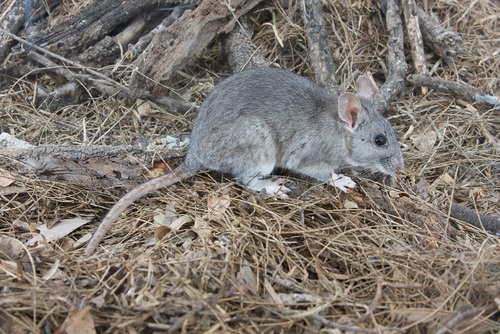
About Neotoma macrotis Thomas, 1893
The big-eared woodrat, scientifically named Neotoma macrotis Thomas, 1893, is a nocturnal rodent belonging to the woodrat genus Neotoma and the family Cricetidae. It is closely related to Neotoma fuscipes, and was formerly included within that species. This species is endemic to western North America. It occurs west and south of the Salinas Valley, ranging from the California Coast Ranges south of Monterey Bay to northern Baja California, and also lives in the Sierra Nevada, extending north to the South Fork American River. Big-eared woodrats range in color from light to dark brown, and typically have a lighter-colored underside. They have characteristic large mobile ears, large eyes, and a long, fur-covered tail. This species is a primarily arboreal herbivore, and acts as an important keystone species in oak and other forest ecosystems. The big-eared woodrat occupies the southern part of what was previously the entire range of the dusky-footed woodrat, while the dusky-footed woodrat itself lives in the northern portion of that range. More specifically, big-eared woodrats are found along the west coast of North America from just south of Monterey Bay to Baja California. They can also be found in the southern Sierra Nevada mountains, across much of Southern California, and have discontiguous populations in California's central valley. Their typical habitats include coastal chaparral, sage scrub, and densely wooded areas, and the species prefers regions that contain coast live oak and have extensive understory plant coverage.