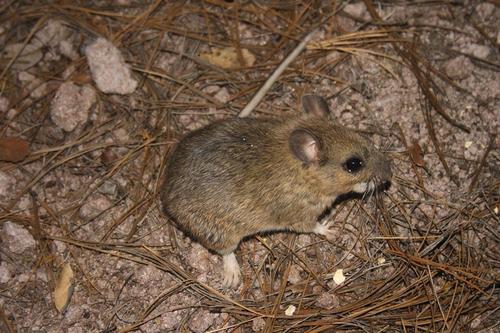
About Neotoma lepida Thomas, 1893
Desert woodrats, scientifically named Neotoma lepida Thomas, 1893, are relatively small for pack rats. They measure 28 to 39 cm (11 to 15 in) in total length, which includes a 12 to 20 cm (4.7 to 7.9 in) tail. They weigh between 122 and 350 g (4.3 to 12.3 oz), and males grow larger than females. Their body color varies between individual animals, ranging from pale gray to cinnamon to near-black. No matter what color the rest of an individual's body is, its underparts and feet are always white, while the otherwise pale fur on the throat is gray at the base. The tail is clearly bicolored, and has more hair and fewer visible scales than the tails of brown rats. Desert woodrats have a narrow snout, long whiskers, and relatively long ears that are nearly the length of their hind feet. In terms of distribution and habitat, desert woodrats range from southeastern Oregon and southwestern Idaho, south through Nevada and western Utah to California in the United States, and into Baja California and extreme northwestern Sonora in Mexico. They generally live in sagebrush scrub areas, chaparral, deserts, and rocky slopes with scattered cactus, yucca, pine/juniper, and other low vegetation, occurring at elevations up to 2,900 m (9,500 ft). They are most abundant in rocky areas with many crevices or rock piles, where they can shelter from predators. Twenty three subspecies were originally recognized, many of which are restricted to small islands in the Gulf of California. However, following assessments from the ASM and IUCN, Neotoma insularis (Townsend, 1912) is now recognized as a separate species distinct from N. lepida.