About Neotoma albigula Hartley, 1894
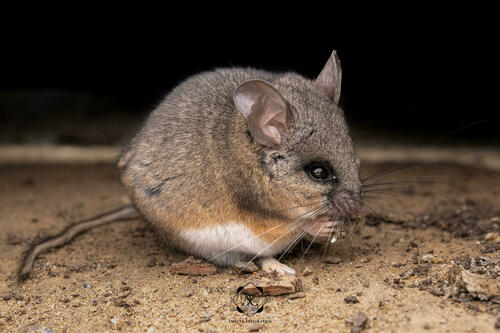
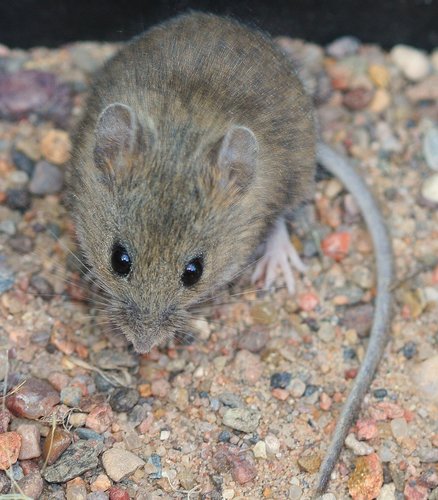
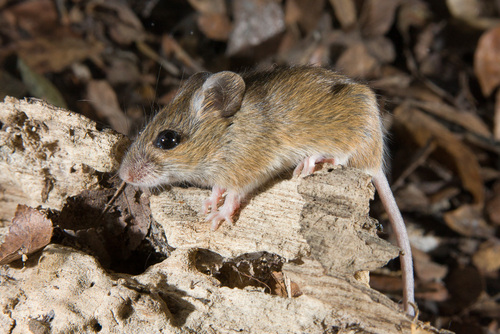
The white-throated woodrat (Neotoma albigula) is a rodent species in the family Cricetidae. Its range extends from central Mexico in the south northward to Utah and Colorado in the United States. In the US, it is primarily a western species, ranging from central Texas west to southeastern California. Populations east of the Rio Grande in New Mexico and Trans-Pecos Texas, previously classified as variants of the white-throated woodrat, have been reassigned to the white-toothed woodrat (N. leucodon) since 1988. The species mostly inhabits the Upper and Lower Sonoran life zones, found from higher-elevation pinyon-juniper woodland down to lower-elevation desert habitats. Like other woodrat species, white-throated woodrats build middens from diverse materials including sticks, cactus parts, and miscellaneous debris. An above-ground chamber inside the midden holds a grass-lined nest that is kept free of feces. In non-rocky areas, dens are typically several feet in diameter and most often built at the base of a shrub for extra cover. In areas with rocky outcrops, the species uses rock crevices, and blocks access to the nesting chamber with sticks and other materials. Molecular data indicates this species diverged from other members of the Neotoma floridana group (Neotoma floridana, Neotoma micropus, Neotoma leucodon) roughly 155,000 years ago, during the Illinoian Stage of the Pleistocene. This timeline matches the oldest known fossils of the species from Slaton, Texas. This rodent is a common fossil in Southwestern cave faunas; over 20 Pleistocene-age fossil localities are known from New Mexico alone. The full range of the white-throated woodrat and its subspecies extends from the southeastern corners of Nevada and California across southern Utah, all of Arizona, to southwestern Colorado, across west Texas, and south into central Mexico. Recognized subspecies and their ranges are: N. a. albigula (Hartley): from northern New Mexico and northeastern Arizona south along the east side of the Sierra Madre Oriental to southern Coahuila, Mexico; also ranges from central Texas to western Arizona, and south along the western side of the Sierra Madre Occidental to central Sonora. N. a. brevicauda (Durrant): Utah and Colorado. N. a. durangae (J. A. Allen): Southwestern Chihuahua and central Durango, Mexico. N. a. laplataensis (F.W. Miller): Utah, Colorado, and Arizona. N. a. latifrons (Merriam): Michoacán, Mexico. N. a. leucodon (Merriam): east of the Rio Grande in New Mexico, Texas, and Oklahoma; also Durango, Zacatecas, San Luis Potosí, Guanajuato, Jalisco, Aguascalientes, Querétaro, Hidalgo, and southeastern Coahuila, Mexico. N. a. mearnsi (Goldman): Arizona. N. a. melanura (Merriam): Central Sonora, Chihuahua, and Sinaloa, Mexico. N. a. melas (Dice): New Mexico. N. a. robusta (Blair): Texas. N. a. seri (Townsend): Northeastern Sonora, Mexico. N. a. sheldoni (Goldman): Northeastern Sonora, Mexico. N. a. subsolana (Alvarez): Coahuila, Tamaulipas, Nuevo León, and Coahuila, Mexico. N. a. venusta (True): Colorado River valley in western Arizona south to Sonora and Baja California, Mexico. N. a. warreni: Colorado, Oklahoma, northeastern New Mexico, and Texas. In general, white-throated woodrats inhabit desert grasslands, semiarid shrublands, saguaro (Carnegiea gigantea) cactus communities, pinyon-juniper (Pinus-Juniperus spp.) woodlands, interior ponderosa pine (P. ponderosa var. scopulorum) forests, and Madrean evergreen woodland (Pinus spp.-Quercus spp.). The white-throated woodrat lives in a range of plant communities from sea level up to 9,200 feet (2,800 m), but is most abundant in Sonoran and Chihuahuan desert grassland and desert shrub habitats. It is generally associated with creosotebush, mesquite, cacti (particularly prickly-pear and cholla (Cylindropuntia spp.)), catclaw acacia, and paloverde. These plants provide the two most critical habitat requirements for the species: cover and succulent plant food that is over 50% water by weight. White-throated woodrats prefer habitats with low tree canopy cover, high shrub and rock cover, and coarse woody debris. They may use natural and human-constructed riparian habitat when it is available. White-throated woodrats are opportunistic feeders and are primarily herbivorous. Their diet includes seeds, fruits, green plant parts, flowers, small amounts of grass, and occasionally beetles (Coleoptera), ants (Hymenoptera), and reptiles. Across the species' range, the most commonly eaten plants include mesquite flowers, leaves, seeds, and bark, cactus flowers, stems, and fruits, and yucca leaves. What the species eats depends on food availability. In Great Basin scrub desert and juniper woodlands in Coconino County, northern Arizona, the white-throated woodrat diet is 29% yucca, 24% juniper, 7% rabbitbrush (Chrysothamnus spp.), 6% sumac, 5% Apache-plume (Fallugia spp.), 4% sagebrush (Artemisia spp.), 4% saltbush, and 3% ephedra (Ephedra spp.). In the Lower Sonoran zone of southern Arizona's Santa Rita Experimental Range, cacti and mesquite are the primary foods eaten. When given a choice between spiny and spineless cacti, white-throated woodrats prefer spiny cacti, possibly because spines are associated with cacti that have higher protein and lower fiber content. The woodrats also place cactus spines around their nests to act as defense against predators. A full list of foods eaten by the species at the Santa Rita Experimental Range is available in work by Vorhies and Taylor. In the southern Great Basin, Navajo yucca (Y. baileyi) is an important food source for this species. White-throated woodrats need large amounts of water, which they obtain from various xerophytic plants, especially cacti. In Organ Pipe National Monument, the species relies heavily on teddybear cholla, buckhorn cholla (Cylindropuntia acanthocarpa), jumping cholla, and goatnut (Simmondsia spp.) for water. In Coconino County, white-throated woodrats get water from evergreen species (Ephedra spp., Yucca spp., and Juniperus spp.), which maintain high year-round water content. The diet of the white-throated woodrat changes seasonally. In Coconino County, the species eats a variety of plants including deciduous shrubs during warm, wet months when plant moisture content is high. During cool, dry months, its diet is mostly limited to evergreen plants. Regardless of season, white-throated woodrats prefer to eat evergreen species. At Carrizo Creek, honey mesquite leaves, flowers, and fruits are the main food eaten from late March through the end of summer. After honey mesquite loses its leaves, white-throated woodrats feed on stored beans, bark, and stems. Some white-throated woodrats store food inside their dens. Of 30 white-throated woodrat dens found in Doña Ana County, New Mexico, 77% contained stored food. The average stored food weight per den was 2.2 pounds (1.00 kg), with a range of 0.1 to 9.3 pounds (0.045 to 4.218 kg) per den. Most stored food consists of mesquite beans, cacti, and forb seeds. In general, white-throated woodrats collect food within a 30 to 50 meter (98-to-164-foot) radius of their dens.