About Neotis ludwigii (Ruppell, 1837)
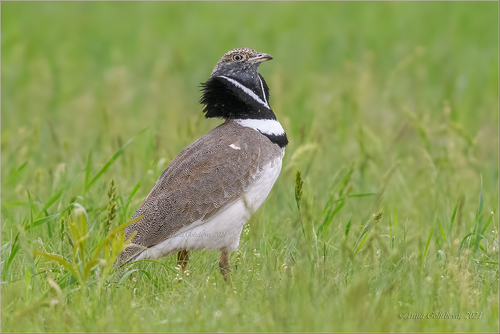
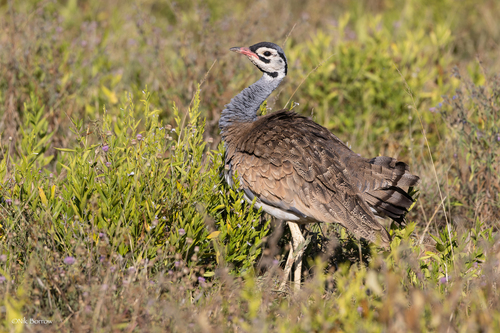
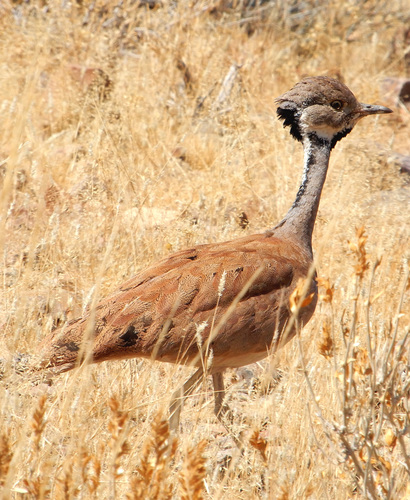
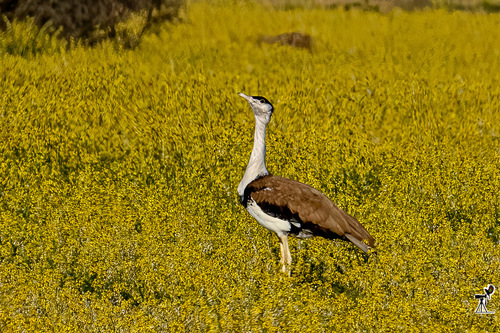
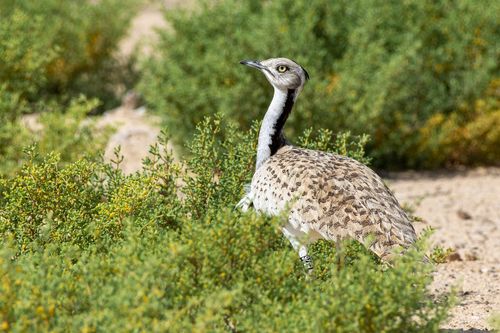
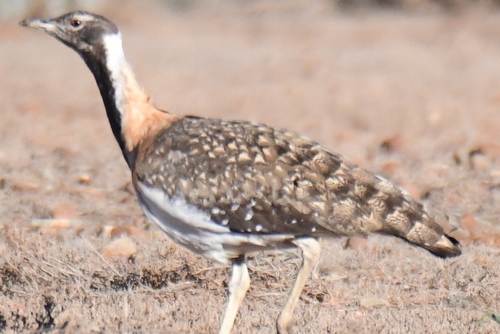
Ludwig's bustard, scientific name Neotis ludwigii (Ruppell, 1837), has a weight range of 3 to 7.3 kg (6.6 to 16.1 lb). Males are much larger, with a mean weight of 6.3 kg (14 lb), while females have a mean weight of 3.4 kg (7.5 lb). Females measure 76 to 85 cm (30 to 33 in) in length, and males measure 80 to 95 cm (31 to 37 in) in length. This species has grey-brown colouring on the face and front neck, and white colouring on the back of the neck and the back of the face. The nape of the neck is dull orange. Females and juveniles differ from adult males in their smaller size and the slightly lighter colour of their front neck and face. Ludwig's bustard is often confused with Stanley's bustard, more commonly known as Denham's bustard (Neotis denhami). Denham's bustard has paler grey colouring on the face and front neck, a browner nape, and distinctive black and white crown stripes on its head, which Ludwig's bustard lacks. Like most bustards, Ludwig's bustard inhabits grasslands and semi-arid regions. Its distribution is generally limited to western Southern Africa, occurring in western South Africa, Namibia, and sometimes Botswana. The species' total range covers approximately 380,000 km² (146,719 sq mi). In the 1980s, the total global population of Ludwig's bustard was estimated between 56,000 and 81,000 individuals. More recent population estimates place the South African population alone at around 114,000 individuals. It was once commonly thought that Ludwig's bustard followed rainfall patterns, but newer research has disputed this claim. There is, however, strong evidence that these birds prefer modified habitats such as agricultural fields and pastures. Ludwig's bustard does not form large flocks. The average group size is 2.13 individuals in summer and 3.56 individuals in winter. Because Ludwig's bustard lives in large, remote, hard-to-access regions and is easily disturbed by researchers, little scientific information is available about its reproductive behaviours. Breeding has been recorded in March in Namibia.