About Neotinea ustulata (L.) R.M.Bateman, Pridgeon & M.W.Chase
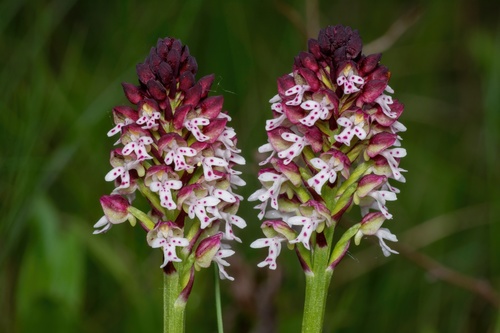
Neotinea ustulata (L.) R.M.Bateman, Pridgeon & M.W.Chase grows from two spherical tubers with thick roots. Older sources suggest the plant may grow entirely underground for 10 to 15 years before its first stem emerges. It produces leaves 3 to 9 cm (1.2 to 3.5 in) long with prominent veins, with a few leaves typically growing around the flower stem. The flower stem can reach a maximum height of 28 cm (11 in), though most are shorter than 13 cm (5.1 in). Flowers are arranged in a dense cylindrical cluster, and a single plant can produce up to 70 individual flowers. The sepals and petals form a 3 mm (0.12 in) reddish-brown hood, which sits above a 4 mm (0.16 in) white lower lip marked with crimson spots. The flowers carry a strong fragrance similar to honey, but they do not produce nectar. N. ustulata blooms from May to June, while its subspecies Neotinea ustulata subsp. aestivalis blooms in July in England. This late-flowering subspecies has a distinct unpleasant aroma, a trait associated with its different set of pollinators. The plant's common name comes from the burnt-like appearance of its flower bud tips. Overall seed set is low, at around 20%, but each seed capsule can hold between 2000 and 4000 dust-like seeds that can travel hundreds of kilometers by wind. Neotinea ustulata is distributed across central and southern Europe, with its main southern populations located in Spain and Greece. It extends north to England and southern Sweden, and east as far as the Caucasus and Ural mountains. It can grow at elevations up to 2,400 m (7,900 ft) in the Carpathian Mountains and the Alps. It most often grows on chalky subsoil in grassland, fens, open pine forest, mountain meadows, valleys, rocky ledges, and wet grasslands, and occasionally grows on acidic soils. The largest population of this species in northwest Europe is found at Parsonage Down, Wiltshire, England. The early-flowering subspecies Neotinea ustulata var. ustulata is pollinated by the parasitic tachinid fly Tachina magnicornis. The late-flowering subspecies Neotinea ustulata var. aestivalis is pollinated by the longhorn beetle Pseudovadonia livida, and possibly also by bees. Neotinea ustulata has very specific requirements for mycorrhizal partners, relying primarily on species in the Rhizoctonia group. One study has also recorded that this species forms partnerships with a Ceratobasidium species. As one of the smallest orchids native to Europe, it generally depends on low-intensity grazing to successfully compete with other plants for sunlight. Grazers do not avoid this plant, however: above-ground parts are often eaten by sheep, cows, rabbits, slugs, and snails, and wild boar sometimes dig up and consume the plant's underground tubers and roots.