About Neoscona domiciliorum (Hentz, 1847)
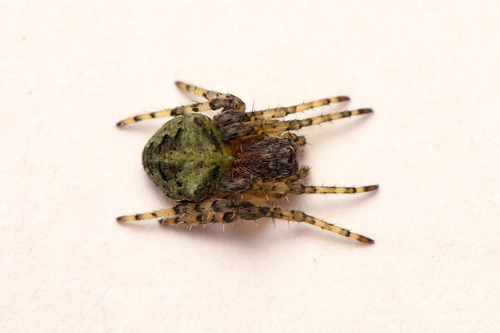
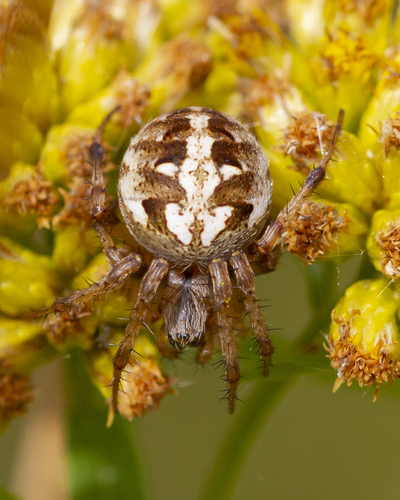
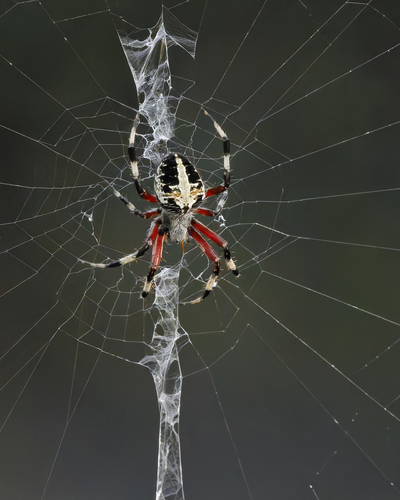
Adult Neoscona domiciliorum can be identified by a bright white or yellow marking on the dorsal side of the abdomen. This marking typically has broad black stripes on both lateral sides, plus a thin transverse white band near the front of the abdomen, that together form a pale cruciform shape. The first segment of each leg is red, while the remaining leg segments are banded with black and pale gray. The underside of the spider is dark, with four white spots on the abdomen; the tip of the abdomen is red. Like other species in the genus Neoscona, Neoscona domiciliorum has a characteristic longitudinal groove on the carapace, which distinguishes it from species in the genus Araneus.
Females of this species are 7 to 16 millimetres (0.28 to 0.63 in) long, and are sparsely covered in short gray hairs. Males are about 8 millimetres (0.31 in) long, and have a relatively small, linear abdomen. Neoscona domiciliorum is endemic to the United States, found southeast of a line connecting Texas, Indiana, and Massachusetts. It prefers woodland habitats, especially moist woods dominated by hardwood trees. Though this species is usually nocturnal, females are commonly found throughout the autumn season in Florida's moist woodlands. They can also be found on buildings, particularly under eaves, where they often go unnoticed due to their nocturnal habits.