About Neoscapteriscus vicinus (Scudder, 1869)
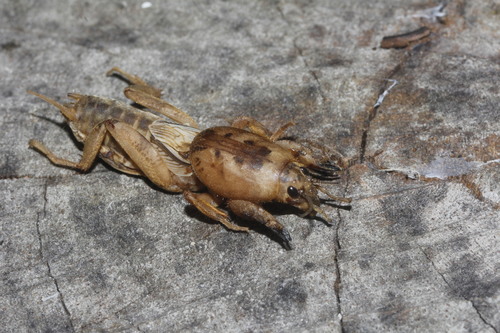
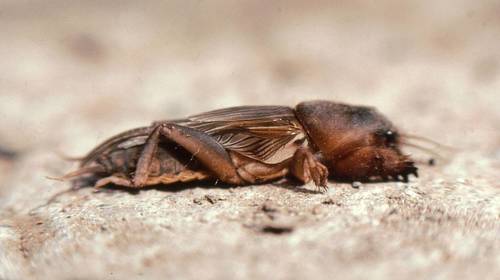
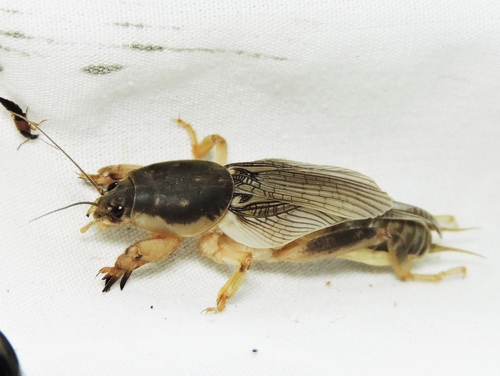
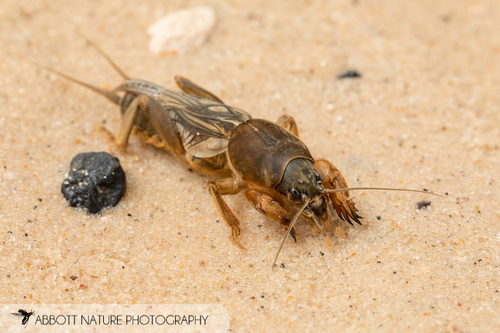
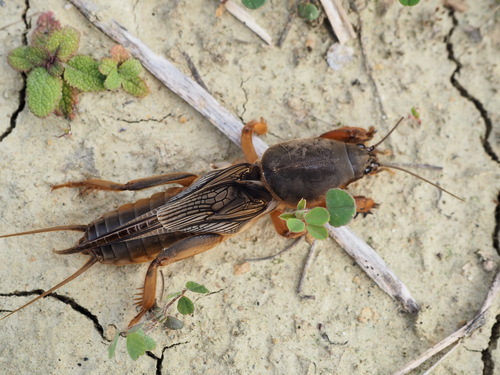
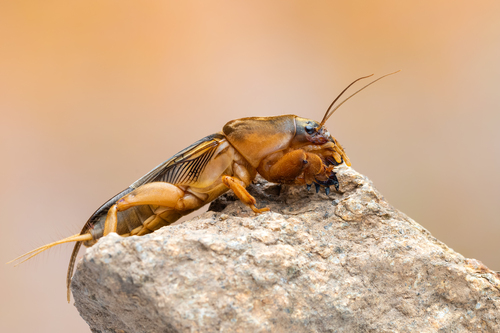
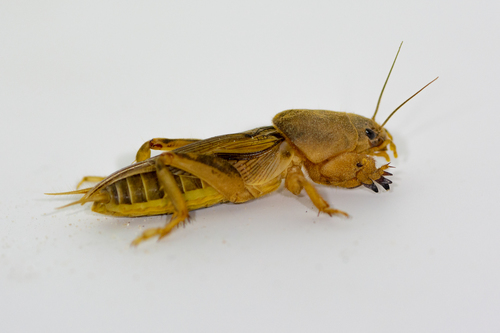
Neoscapteriscus vicinus (Scudder, 1869) is a medium-sized mole cricket. Members of the Neoscapteriscus genus are characterized by having two sharp claws and a blade-like process with a sharp edge on their fore legs; other mole crickets have three or four claws. This species is yellowish-brown with a dark prothorax. It can be distinguished from the closely similar Neoscapteriscus borellii by its two claws, which are almost touching at their base, while the claws of N. borellii are widely separated. Only male N. vicinus produce song, which is a loud trill with a frequency of 130 Hz. N. vicinus is native to South America. After arriving in the United States, it has expanded its range, which now runs from North Carolina to Louisiana, covers all of Florida, and extends west to Texas. Though it is primarily considered a pest of turf and grassland, it also damages many crop plants, including tomatoes, strawberries, vegetables, peanuts, sugarcane, tobacco, and ornamental plants. The tawny mole cricket, as this species is commonly called, burrows in sandy soil and creates galleries, usually in the upper 25 cm (10 in) of the ground; burrow depth depends on temperature and soil moisture content. In Florida, adults are active in spring and again in autumn. They complete one full life cycle during the summer, and overwinter as large nymphs. N. vicinus is herbivorous, feeding on the roots and young shoots of plants, and it also causes plant damage through its burrowing activities. Breeding occurs in spring and autumn. Males call shortly after sunset to attract females. After copulation, the female lays between 25 and 60 eggs in an underground chamber, then blocks the chamber's entrance with soil. The eggs hatch roughly 3 weeks later. Nymphs take several months to fully develop, passing through eight to 10 moults. To reduce damage caused by Neoscapteriscus mole crickets in Florida, biological pest control programs were carried out using natural enemies introduced from South America. The program was considered successful by 2004, when the University of Florida's program was shut down. A 2006 summary publication announced success: a 95% reduction in mole cricket populations in northern Florida, with biological control agents potentially spreading to all regions of Florida. Three introduced natural enemies target the crickets. Larra bicolor is a parasitoid wasp that deposits eggs on adult mole crickets. The fly Ormia depleta acts in a similar way, also laying eggs on adult mole crickets; in both cases, the developing larvae consume the host's tissues. The mole cricket nematode Steinernema scapterisci releases a bacterium that causes sepsis and death in its mole cricket host. In 2016, a graduate student in economics and her committee published an economic analysis of the full 25-year biological control program. The analysis counted salaries, equipment, and supplies as program inputs, and calculated the output as the reduction in mole cricket damage to cattle pastures, based on a survey of ranchers across Florida. The analysis found a cost-benefit ratio of 1 to 52. This calculation did not include benefits to turf grass (lawns, playing fields, golf courses), vegetable production, or any areas outside of Florida.