About Neopsephotus bourkii (Gould, 1841)
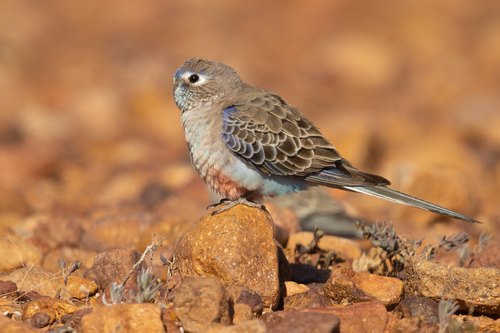
Bourke's parrot (Neopsephotus bourkii) is a relatively small parrot species. Adults measure between 18 cm and 23 cm in total length, with a tail length of approximately 9 cm. Females are slightly smaller on average than males: male body mass ranges from 47 g to 49 g, while female body mass ranges from 41 g to 49 g. Both sexes look nearly identical until they reach nine months of age, when they develop full adult plumage. In the wild, wild Bourke's parakeets have overall brown colouration, with a pink abdomen, pinkish breast, and blue rump. They have dark-brown legs with zygodactyl toes, and a yellowish-brown bill. Adult males have a blue forehead, while adult females have little to no blue on the forehead. The species' feather colouration lets it blend into the reddish soil of its arid native habitat. Bourke's parrot produces a variety of calls: its most common call is described as a "soft twitter", and it also makes "chu-vee", "chirrup chirrup", and alarm calls of "kik-kik-kik". This parrot is native to Australia. It is a nomadic species that follows water and food sources, giving it a very large range across the continent. It is mainly found in sparsely populated inland areas, though it is also known to live in urban areas. Its range extends from south-western Queensland through western New South Wales, across Central Australia to far northern South Australia, and into parts of Western Australia. Its primary habitat is made up of areas dominated by Acacia species, especially mulga, as well as spinifex plains. It can also be found in native cypress and open eucalypt woodlands. Bourke's parrot is both arboreal and terrestrial: it perches and nests in trees, but also frequently spends time on the ground where it can easily camouflage. Its flight is short but swift, with periods of gliding interspersed between powered flight. It usually flies close to the ground in quick bursts when travelling between trees. It produces very few wing beats, which create an audible whirring sound. In the wild, Bourke's parrots typically live in pairs or small groups of around four to six individuals. The species will also gather in larger flocks of hundreds, particularly during periods of drought.