About Neophron percnopterus (Linnaeus, 1758)
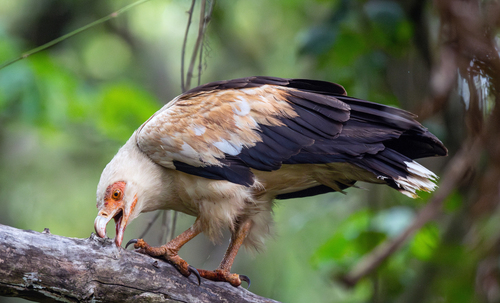
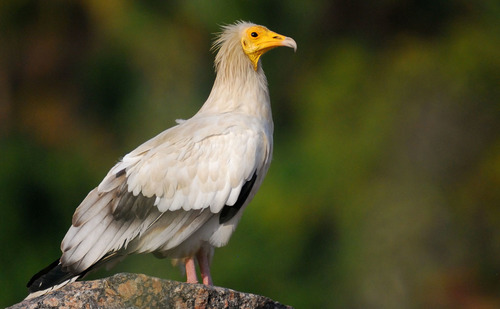
This species, Neophron percnopterus (Linnaeus, 1758), commonly called the Egyptian vulture, has the following physical description. Adult plumage is primarily white, with black flight feathers on the wings. Wild individuals typically have a rusty or brown soiled tint to their white plumage, which comes from contact with mud or iron-rich soil; captive specimens without access to soil have clean white plumage. This tinting has been suggested to be an example of cosmetic colouration. The bill is slender and long, with a hooked tip on the upper mandible, and the nostril forms an elongated horizontal slit. Long neck feathers form distinct hackles. The wings are pointed, with the third primary feather being the longest, and the tail is wedge-shaped. Adult legs are pink, while juvenile legs are grey. Claws are long and straight, and the third and fourth toes have slight webbing at their base. The bill is black in the nominate subspecies, but pale or yellowish in adults of the smaller Indian subspecies N. p. ginginianus. Rasmussen and Anderton (2005) note this variation requires further study, particularly because the described subspecies N. p. rubripersonatus has an intermediate black-tipped bill. Facial skin is yellow and unfeathered down to the throat. Sexes cannot be distinguished by plumage, but breeding males have a deeper orange facial skin colour than females. Females average slightly larger, and are 10–15% heavier than males. Juvenile birds are blackish or chocolate brown with black and white patches, and do not develop full adult plumage until approximately five years of age. Adult Egyptian vultures measure 47–65 cm from the tip of the beak to the end of the tail. Males of the smaller N. p. ginginianus measure 47–52 cm in length, while females of this subspecies measure 52–55.5 cm. Wingspan is approximately 2.7 times body length. Individuals from Spain weigh around 1.9 kg, while the Canary Island subspecies N. p. majorensis, an example of island gigantism, has an average weight of 2.4 kg. The Egyptian vulture is one of the smallest true Old World vultures; only the palm-nut vulture is marginally lighter, and the palm-nut vulture may be an outlier among other vultures. Egyptian vultures are widely distributed across the Old World, with a breeding range extending from southern Europe to northern Africa, and east to western and southern Asia. They are rare vagrants in Sri Lanka. They occur mainly on dry plains and lower hills. In the Himalayas, they can be found up to around 2,000 m in summer, and in Armenia, breeding pairs have been recorded up to 2,300 m above sea level. Most Egyptian vultures in the European subtropical zone migrate south to Africa for winter. Vagrants have been recorded as far south as South Africa, though the species bred in the Transkei region before 1923. They nest mainly on rocky cliffs, but will sometimes use ledges on tall city buildings or large trees. Like many other large soaring migrants, they avoid long crossings over water. Italian migrating birds cross through Sicily into Tunisia, making short sea crossings via the islands of Marettimo and Pantelleria, with rare stops on Malta. Migrants passing through the Iberian Peninsula cross into Africa over the Strait of Gibraltar, while others cross further east through the Levant. In summer, some African birds travel further north into Europe, and vagrants have been recorded in England, Ireland, and southern Sweden. Migrating birds can sometimes cover 500 km in a single day, until they reach the southern edge of the Sahara, 3,500 to 5,500 km from their summer breeding grounds. Non-breeding age young may overwinter in the grassland and semi-desert regions of the Sahel. Egyptian vultures are most often seen alone or in pairs, soaring in thermals alongside other scavengers and birds of prey, or perched on the ground or on top of a building. On the ground, they walk with a waddling gait. They feed on a wide range of food items, including mammal faeces including human faeces, insects found in dung, carrion, vegetable matter, and sometimes small animals. It is the only Old World vulture species that regularly feeds on faeces. Carotenoids, primarily lutein, absorbed from the plant matter in the ingested excrement produce the vultures' bright yellow facial colour. When feeding at a carcass alongside other vulture species, Egyptian vultures typically stay on the periphery and wait until larger vulture species have left. Pairs may also scrounge food from other vultures, especially griffons. Recently fledged young will sometimes fly to other nests, compete with other young vultures for food, steal food, or even solicit food from unrelated adults bringing food to the nest. Wild rabbits (Oryctolagus cuniculus) make up a significant portion of the diet of Spanish Egyptian vultures. In the Iberian Peninsula, landfills are an important food source, and Egyptian vultures are more likely to occupy territories close to landfill sites. Research indicates that feeding on ungulate faeces provides the carotenoid pigments that create the species' bright yellow and orange facial skin, and the ability to assimilate these pigments may act as a reliable signal of individual fitness. Egyptian vultures are mostly silent, but produce high-pitched mewing or hissing calls at the nest, and screeching noises when squabbling at a carcass. Juvenile birds have been recorded making a hissing croak in flight. They also hiss or growl when threatened or angry. Egyptian vultures roost communally on large trees, buildings, or cliffs. Roost sites are usually chosen close to a dump or other suitable foraging area. In Spain and Morocco, summer roosts are made up mostly of immature birds. Large dead pines are the preferred roost trees. The number of adult birds at roosts increases through June. It is thought that breeding adults can forage more efficiently by joining the roost and following other birds to the best feeding areas. Breeding birds that failed to raise young will also join non-breeding birds at the roost in June. Allopreening has been observed in Canarian Egyptian vultures between mated pairs, as well as between unrelated same-sex individuals, particularly females. The nominate population, especially in Africa, is known for using stones as tools. When a large egg, such as that of an ostrich or bustard, is found, the bird carries a large pebble in its bill, walks to the egg, and swings its neck down to toss the pebble at the egg. This process repeats until the egg cracks from the impacts. The birds prefer rounded pebbles over jagged rocks. While this behaviour was once thought to have been first reported by Jane Goodall in 1966, it was already known to local African people, and was first published by J. G. Wood in 1877. This stone-tool behaviour has only been reported in African populations, and has never been recorded in N. p. ginginianus. Experiments with both hand-reared and wild birds suggest this behaviour is innate, not learned from observing other birds, and is triggered once birds associate eggs with food and have access to pebbles. Brown-necked ravens take advantage of this ability to crack ostrich eggs: they wait in groups for the vulture to crack the egg, then collectively mob the vulture and steal the broken egg through kleptoparasitism. A second case of tool use, recorded in Bulgaria, involves the vulture using a twig as a tool to roll up and gather strands of wool to line its nest.