About Neophema petrophila (Gould, 1841)
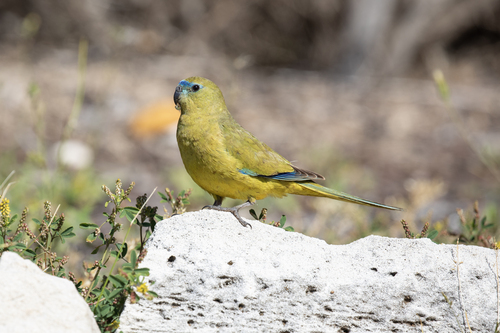
The rock parrot (Neophema petrophila) measures 22 to 24 cm (8+3⁄4 to 9+1⁄2 in) in length, has a 33–34 cm (13–13+1⁄2 in) wingspan, and weighs approximately 50–60 g (1+3⁄4–2 oz). It is a small, lightly built parrot. Males and females have similar overall appearance: their upperparts, including the head and neck, are predominantly olive-brown, and their underparts are more yellowish. A dark blue band stretches across the upper forehead between the eyes; this band is bordered above by a thin light blue line that extends behind the eyes, and below by a thicker light blue band across the lower forehead. The forecheeks and lores are light blue. Adult females have a slightly duller dark blue forehead band and less blue coloration on the face. The wings are predominantly olive, with a two-toned blue leading edge when folded. Primary flight feathers are black with dark blue edges, while inner wing feathers are olive. The upper surface of the tail is turquoise and edged with yellow. The breast, flanks, and abdomen are olive-yellow, becoming more yellow closer to the vent. Except for the feathers on the nape, which are white at the base, all feathers on the head and body have grey bases; these base colors are not normally visible. The bill is black with pale highlights on both mandibles, and the cere is black. The orbital eye-ring is grey, the iris is dark brown, and the legs and feet are dark grey, with a pink tinge on the soles and the rear of the tarsi. Subspecies zietzi is similar in size to the nominate subspecies, but has overall paler, more yellowish plumage. Its plumage darkens with wear, and old individuals may be indistinguishable from the nominate subspecies. Juvenile rock parrots are duller, darker olive across their entire body, and either lack a blue frontal band or have an indistinct one. Their primary flight feathers have yellow fringes. Juveniles start with a yellowish or orange bill, which turns brown by ten weeks of age. Juvenile females have pale oval spots on their fourth to eighth primary flight feathers. Juveniles moult into immature plumage when they are a few months old. Immature males and females closely resemble adult rock parrots, but have worn-looking flight feathers. They then moult into full adult plumage when they reach twelve months old. The rock parrot may be confused with the elegant parrot in Western Australia, or the blue-winged parrot in South Australia, both of which have similar (though brighter) olive plumage. Both of these similar species also have yellow lores, and the blue-winged parrot has much bluer wings. The orange-bellied parrot differs from the rock parrot with brighter green plumage and green-yellow lores. The rock parrot lives along the coastline of southern Australia in two separate disjunct populations. In South Australia, it occurs as far east as Lake Alexandrina and Goolwa, though it is rare on the Fleurieu Peninsula. It was recorded further east at Baudin Rocks near Robe, South Australia in the 1930s, but has not been seen there since. It is more common along the coastline of northeastern Gulf St Vincent between Lefevre Peninsula and Port Wakefield, and across Yorke Peninsula, crossing Investigator Strait to Kangaroo Island, the Gambier Islands, and the Eyre Peninsula from Arno Bay to Ceduna, plus the nearby Nuyts Archipelago. In Western Australia, it ranges from the Eyre Bird Observatory in the east, along the southern and western coastline to Jurien Bay Marine Park. It becomes less common further north to Kalbarri and Shark Bay, and has been historically recorded at Houtman Abrolhos. The rock parrot is generally non-migratory (sedentary), though individual birds may disperse over 160 km (100 mi) after breeding. Some individuals stay year-round on the offshore islands where they breed. Rock parrots are almost always found within a few hundred metres of the coast, down to the high-water mark, though they may occasionally follow estuaries a few kilometres inland. Their preferred habitat is bare rocky ground or low coastal shrubland made up of plants such as pigface (Disphyma crassifolium clavellatum), saltbush (Atriplex) or nitre bush (Nitraria billardierei). The species has also been found in sand dunes, saltmarsh, and under sprinklers on the golf course on Rottnest Island. They tend to avoid farmland.