About Neophema chrysostoma (Kuhl, 1820)
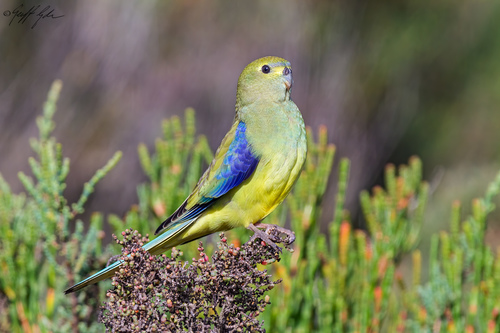
This parrot species measures 20 to 24 cm in length and weighs approximately 55 g, and is sexually dimorphic. Both sexes have predominantly olive-green base plumage. Adult males have a two-toned band across the upper face that does not reach the eyes: the upper portion of the band is ultramarine, and the lower portion is paler turquoise blue. Males have a yellowish crown, pale green throat and breast, yellow belly, deep blue wing coverts and under wing coverts, a blue-grey tail, a blue-grey bill, and brown irises. Adult females are duller overall, with dull olive underparts, less blue plumage on the wings, and a less distinct frontal face band. Juveniles are dull olive green, with slate-blue wings and no frontal face band. The larger amount of blue on the wings distinguishes the blue-winged parrot from the elegant parrot and the orange-bellied parrot; the elegant parrot has overall more yellow-green plumage, while the orange-bellied parrot has overall more bright green plumage. The blue-winged parrot is distributed across southeastern Australia. In eastern South Australia, its range extends north to the Flinders Ranges, and it occurs across all of Victoria. Its occurrence is more sporadic across central and western New South Wales, extending into Queensland as far north as Diamantina National Park. It inhabits open habitats including savannah woodland, grasslands, orchards, farmlands, marshes, heath, and dunes, up to 1,200 m (3,937 ft) above sea level. This is one of only three parrot species that makes regular annual migrations across a sea or ocean. Most individuals migrate between Tasmania, where they breed during spring and summer, and the Australian mainland, where they spend the winter. Some individuals stay in Tasmania over winter, and others remain on the mainland to breed during summer. The species is a spring visitor to King Island in the Bass Strait.