About Neopanax colensoi (Hook.fil.) Allan
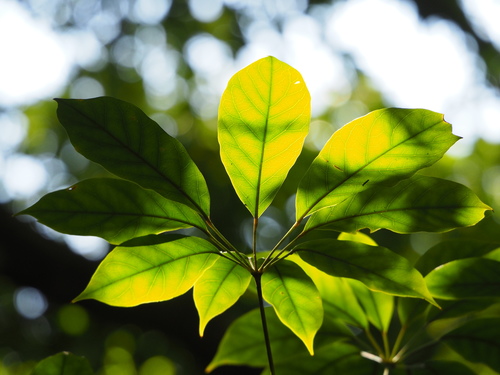
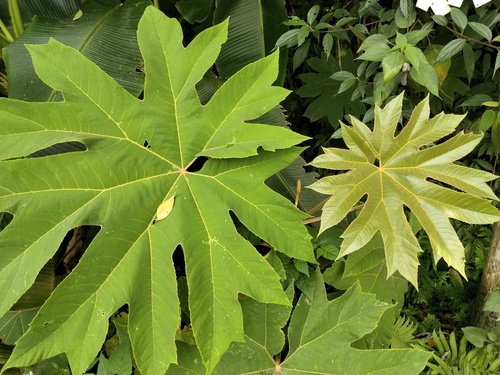
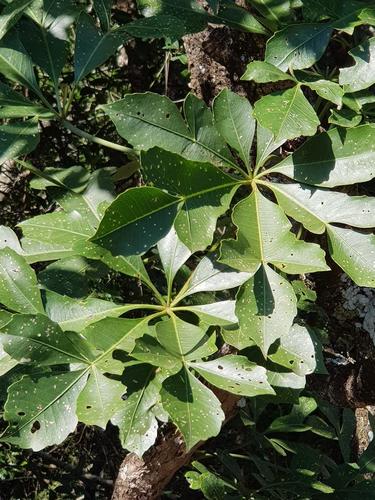
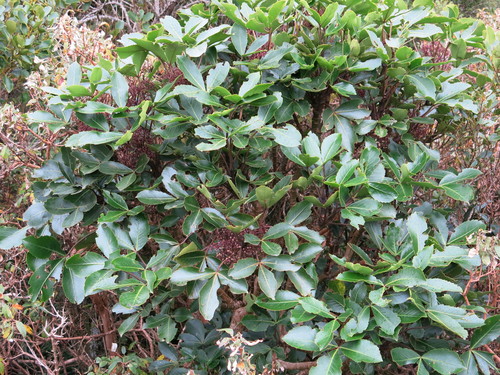
This species, currently classified as Neopanax colensoi (Hook.fil.) Allan, is also frequently referenced under the synonym Pseudopanax colensoi. It is commonly called mountain fivefinger, a name that comes from its leaf structure: each leaf holds five to seven leaflets, with the middle leaflet the longest, and leaflets getting progressively shorter toward the outer edges, resembling the fingers of a human hand. It most often starts as a shrub, and frequently grows into a small canopy tree reaching up to around 8 meters tall, with large spreading branches. Its leaves are compound with large glossy yellowish-green leaflets, each 12–25 cm long and around 5–10 cm or more wide, with toothed, serrated edges; all leaf stalks are purplish. Individual leaflets have a size gradient from the longest central leaflet to shorter outer leaflets, matching the finger shape that gives the species its common name. It produces clusters of 10 to 15 whitish-green flowers arranged in small, umbrella-shaped clusters; these small clusters group into larger clusters that grow from the plant's purplish stalks. The species is dioecious, with separate male and female individuals; only female plants produce fruit. Female fruit is dark in color, less than 1 cm in diameter, dark purple when ripe, and holds exactly two seeds per fruit. Neopanax colensoi is endemic to New Zealand. As of 2017, it is not considered a threatened species, and three subspecific taxa are currently recognized within New Zealand. It occurs naturally across much of the country, and is a common species that thrives in many of New Zealand's climates. In the Nelson and Marlborough regions, it grows from sea level up to over 1,200 m above sea level. It is particularly common in populations across the South Island, especially around the Otago and Dunedin area on the South Island's east coast, and south of Banks Peninsula in Canterbury. It is occasionally found in the North Island along the Coromandel Range. Neopanax colensoi var. colensoi is apparently absent from the South Island's West Coast. The species has preferred habitat conditions: it favors areas away from water, with nutrient-rich soils. N. c. var. colensoi grows in mountainous areas between 300 and 800 m above sea level, in low alpine forests and scrubland, while other varieties such as ternatus grow at higher elevations. If an individual is removed from an established N. colensoi population, it is most often quickly replaced by another member of the same plant family. Other Neopanax species have different habitat preferences: some grow well in poor soil, dry shaded areas, and have a divaricating growth habit, some are used as small decorative garden plants, and some are grown in nurseries for vegetation cover. Other Neopanax species are also used as shrubs in some landscaping. Root pruning of N. colensoi dramatically reduces its growth, unlike the practice seen with other Neopanax species. For life cycle and phenology: Neopanax colensoi flowers and fruits between October and March. For most Neopanax species, fruit ripens between January and April, from summer to autumn. The average lifespan of a Neopanax species is 15–20 years. N. colensoi seeds require cold, slightly damp soil for 1 to 3 months to achieve good germination, and overall take approximately 6 months to germinate because they need these specific cool temperature conditions. N. colensoi seeds do not store well. The seeds of this species are typically dispersed by animals, water, or wind, the most common plant dispersal methods; dispersal carries seeds away from the parent plant to give seeds a better chance of survival.