About Neolentinus ponderosus (O.K.Mill.) Redhead & Ginns
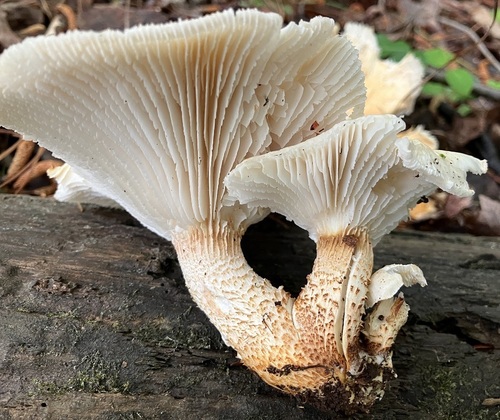
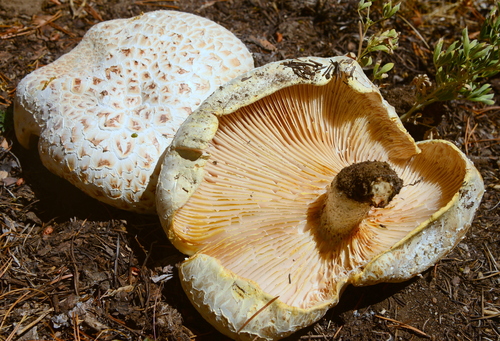
The fruit bodies of Neolentinus ponderosus have convex to flattened caps 5–50 centimetres (2–19+1⁄2 in) in diameter. The cap surface is covered with small cinnamon-brown scales called squamules, and the cap margin is usually curved inward when young. The fungus has narrow, closely spaced gills that are adnate to decurrent. Short gills called lamellulae fill the gaps between full-length gills, extending about two-thirds of the way to the stipe. The gill edges are serrated, shaped like a saw, which gives the species its common name. Gills start whitish and age to light buff or light orange. The stipe measures 2.5–20 cm (1–7+3⁄4 in) long and 2–10 cm (3⁄4–4 in) thick. Its surface is reddish-brown and covered in small scales; these scales are less dense on the upper half of the stipe, which is more whitish or buff in color. Fruit bodies produce a spore print that ranges from white to buff. Under the microscope, spores are somewhat spindle-shaped when viewed from the side, and elliptical when viewed from the front. They measure 8–10.5 by 3–5.5 μm and are inamyloid. Spore-bearing cells called basidia are thin-walled, club-shaped, four-spored, and measure 26–36 by 5–8.8 μm. Cystidia on both the faces and edges of the gills are thin-walled, hyaline (translucent), narrowly club-shaped, and measure 26–36 by 5–8.8 μm. The cap cuticle is made of threadlike hyphae 4.4–8 μm in diameter. The cap flesh consists of interwoven thick- and thin-walled hyphae that measure 2.5–6 μm in diameter. Clamp connections are present in the hyphae. Neolentinus ponderosus is a saprophytic species that grows on conifer stumps and logs, most often ponderosa pine. It causes brown rot in wood, breaking down hemicellulose and cellulose to create brown discoloration, followed by cracking of the wood into roughly cubical pieces. Fruit bodies grow singly or in small clusters, and typically prefer open areas with direct sunlight. This fungus is only found in the Pacific Northwest region of western North America. It produces fruit bodies in late spring, or later in summer in mountainous areas. Young Neolentinus ponderosus mushrooms are edible, but become tough when they mature. Mature specimens can be made palatable by longer cooking or parboiling. The flesh has a faint fruity or indistinct odor and a mild taste. It is a prized edible among the Rarámuri Indians of Mexico.