About Neolentinus lepideus (Fr.) Redhead & Ginns
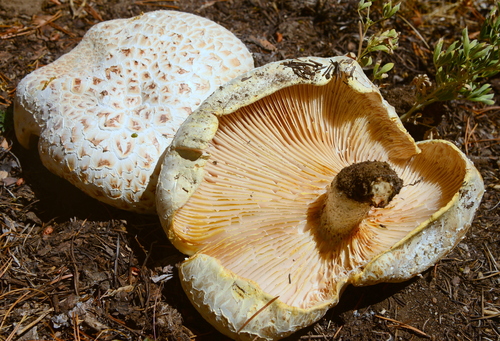
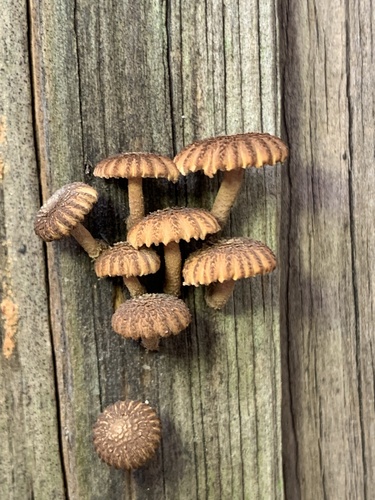
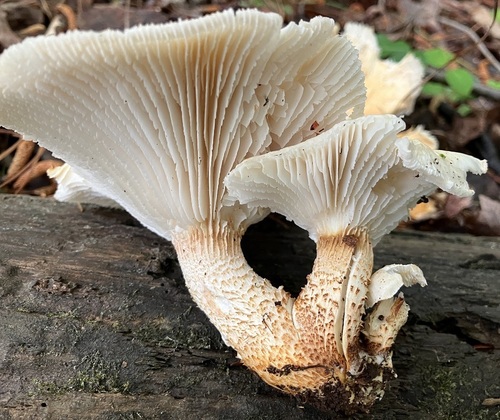
The fruit bodies of Neolentinus lepideus are tough, fleshy agarics that vary in size. When young, the cap is convex, and it flattens as it matures while the cap edge remains curved inward. The cap can grow up to around 13 centimetres (5 inches) across, and the stem reaches up to 12 cm (4+3⁄4 inches) tall. The cap cuticle ranges in colour from white, cream, to pale brown, and is distinctly covered with dark scales arranged in concentric rings that grow denser toward the depressed centre of the cap. The gills are white, and attach to the stem in an adnate, subdecurrent, or decurrent arrangement. Both the gills and stipe turn dark reddish as the mushroom ages. The stem is white, and is covered with dark scales in the area below its white ring. The mushroom has an odour somewhat similar to anise, and has no distinct taste. The flesh is tough, and becomes tougher as the mushroom matures. The spore print is white, and the spores themselves are cylindrical. The spores measure 8–12.5 by 3.5–5 micrometres. Fruit bodies of Neolentinus lepideus grow singly or in tufts out of dead and decaying coniferous wood; it favours pines (Pinus), including old stumps, logs, and standing timber. It can also grow in gardens, on man-made wooden structures like old railroad ties, and in unusual locations such as coal mines. It grows on non-coniferous hardwood less frequently. Its fruiting season runs from spring to autumn, and it is common in Europe and North America. In North America, it fruits from May to November, with a slightly shorter season in western parts of the continent. There are multiple confirmed reports of this species occurring in the Western Cape, South Africa. Neolentinus lepideus gains nutrition through saprotrophy. It is an important decomposer in woodland ecosystems, and also causes wet rot in building timber. This fungus is tolerant of wood treated with creosote and other wood preservatives, and has been used in experiments to test how effective these preservative treatment methods are.