About Neofibularia nolitangere (Duchassaing & Michelotti, 1864)
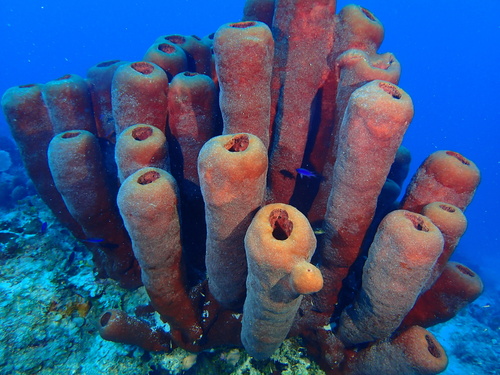
Neofibularia nolitangere is a massive sponge that typically grows to around 30 centimeters wide and 30 centimeters tall, and can sometimes reach 1 meter in width. It has a central cavity (or atrium) with thick walls, and takes on a range of different forms across different areas of the Caribbean. In the Bahamas, it most commonly grows as a set of rounded lobes, with a cup-shaped depression called a cloaca at the apex of each lobe. Several openings called osculi are located within these depressions; these openings slope diagonally to connect to the atrium, and water is expelled out through the osculi. Sometimes this sponge grows in an encrusting form, creating a shallow layer of tissue across its substrate. In other locations, it grows as a series of concentric mounds with smaller cloacal openings, or as large vase-shaped structures that grow either singly or in groups, and sometimes fuse together laterally. The sponge’s general body color is deep brown or dark red. The inner surfaces of the cloaca are rougher than the sponge’s outer surface, which is smooth but not shiny. The sponge has a compressible, fragile, crumbly consistency, but handling it is not recommended. Contact with this sponge causes a stinging smarting sensation and skin numbness, and repeated exposure can trigger a more severe allergic reaction. Neofibularia nolitangere occurs in the Western Atlantic Ocean and the Caribbean Sea. Its range extends from Florida and the Bahamas through the Greater and Lesser Antilles, and south as far as Panama, Colombia, and Venezuela. It grows at depths between 3 and 46 meters (9.8 to 150.9 feet). Parasitic polychaete worms Haplosyllis spongicola are commonly found in this sponge; small white bodies of these worms often protrude from the inner cloaca walls. An individual sponge can host tens of thousands of these worms, and the worms can sometimes make up as much as five percent of the sponge’s total weight. Several species of fish are associated with Neofibularia nolitangere. This includes the gobies Elacatinus horsti and Elacatinus chancei, which live inside the sponge’s apertures and feed largely on the parasitic worms.

